01 / The opportunity
Why might someone buy this?
A purpose-shaped stand might make left-foot placement and charging checks more repeatable than a loose phone pad while taking less desk and bag space than Home Station. Anker listed a generic wireless pad at $18.99, so a $39 EMO-specific concept must show a real advantage; owners with a working skateboard may have no reason to pay.
Who might need it?
- EMO Go Home owners who take EMO to a second desk and would otherwise pack the Home Station, plus owners whose small skateboard charger no longer works after they seek support.
- Owners with a working skateboard or no travel routine are a comparison group; they may reasonably prefer what they already own. PocketDock would not make EMO safe on an exposed table edge or replace its Home Station at home.
The Go Home package is built around a Home Station that enables automatic return and uses a larger mat. That is useful on a normal desk but awkward to carry for an occasional visit. In an August 2026 forum exchange, an owner specifically asked about a portable charge-and-carry option and said an earlier box-plus-skateboard setup had stopped being available to them after the skateboard failed.
Carry Mode, documented by LivingAI in April 2025, helps unload EMO's servos while it is carried. It does not make the Home Station compact or establish a safe smaller charger. A recent request for the bag shown in a Carry Mode video suggests accessory interest, but the charging need and buying intent still need separate testing.
02 / Existing solutions
How owners handle it today.
| Current solution | What it does | What remains |
|---|---|---|
| Original box with the skateboard charger ↗ | A recent owner says they used this combination away from home; an older travel account also describes a skateboard connected to a power bank. | The recent owner's skateboard failed, and Go Home buyers may not have one. The box is protective but bulkier than an everyday desk stand. |
| Pack the official Home Station ↗ | The supplied Go Home charger provides LivingAI's automatic return and virtual fence in its intended setup. | The owner described it as inconvenient to bring along. A separate $99 replacement station is still the same large format and is not a travel-specific solution. |
| Generic Qi charging pad ↗ | Owners have historically reported charging EMO with its left foot aligned over a Qi pad, potentially offering a cheap compact option. | A specific pad's compatibility, placement tolerance and heat are unverified; a bare pad provides no repeatable foot guide or stable boundary. |
What a better product would need to do
- Be materially smaller than Home Station while remaining stable on a level desk; do not advertise automatic return or a virtual fence.
- Guide the left foot to the verified receiver position without trapping servos, covering sensors or making EMO prone to tipping.
- Use a tested low-power wireless module and appropriate power supply; document temperature, input behavior and safe disconnection before any performance claim.
- Outperform an unmodified generic Qi pad in repeat placement tests, or drop the concept. State clearly that charging occurs in the open at the destination, not inside a closed carry bag.
03 / Research evidence
How strong is the evidence?
Opportunity type: Explicit owner inconvenience and niche charging accessory gap
The clearest current signal is an August 26–27, 2026 forum exchange about traveling with EMO and charging without the large Home Station. A separate May 23, 2026 post asks about an EMO bag. Older users proposed a printed carry charger and tried generic Qi pads, but these are historical context. The evidence does not estimate how often owners travel or how many would pay for a dedicated stand.
EMO and EMO Go Home remain listed for purchase by LivingAI at $279 and $369 respectively. The standard bundle includes the skateboard charger; Go Home features the larger Home Station. LivingAI sells Home Station separately for $99 and introduced Carry Mode in firmware 2.8.0. A recent owner described traveling with EMO and wanting a compact charging solution.
There may be a small segment of Go Home owners who would prefer a compact, purpose-shaped manual stand to packing Home Station or positioning a generic pad. This is an inference from usage examples, not a proven category demand signal.
How many Go Home owners travel with EMO, what charging gear they already own, EMO hardware-revision differences, the module/receiver alignment tolerance, heat behavior, power-interruption behavior, component and compliance costs, and willingness to pay compared with a generic Qi pad.
Selected evidence
Recent owner asks about an EMO carry-and-charge accessory ↗
An owner asked whether a carry accessory was sold and explained that taking the Home Station away from home was inconvenient. The request includes interest in a smaller portable charging method.
Post: · Checked: One self-selected owner account within a longer historical thread; neither prevalence nor willingness to pay is known.Owner describes original-box and skateboard workaround ↗
The owner said they had carried EMO in its box with its skateboard, but the skateboard stopped working. The reply displayed three likes when checked.
Post: · Checked: Same owner and thread as the preceding source; this is one experience, not independent corroboration or a verified charger fault diagnosis.Separate recent question about the Carry Mode bag ↗
A separate participant asked about the bag shown in EMO Carry Mode material.
Post: · Checked: Demonstrates carrying-accessory interest, not specifically demand for a charging stand; no engagement count was visible on that question.Official EMO Go Home listing ↗
The current $369 package is presented with the larger Home Station, automatic return and Home Fence.
Checked: Manufacturer listing does not state installed base or prove the absence of all other travel chargers.Historical Qi charging alternative ↗
Owners discussed using low-power Qi charging for EMO Go Home by placing the left foot over a pad.
Post: · Checked: Historical peer advice, not manufacturer certification or current validation of any particular module or hardware revision.The August 26–27, 2026 exchange includes a direct portable-charging request and an owner account of a failed skateboard; the owner's follow-up showed three likes when checked. A separate May 23, 2026 bag question adds recent carrying interest, and an August 2025 carrying thread showed five likes. Those are self-selected interactions, not a count of owners or evidence of sales.
Search interestFocused searches for EMO Go Home travel charger, portable EMO charger and EMO skateboard charger surfaced recent owner discussions, historical workarounds and official charging products. No reliable search-volume source or reproducible Google Trends result was obtained on 2026-09-29; possible SEO queries are unmeasured editorial hypotheses.
04 / Product design
How the product could work.
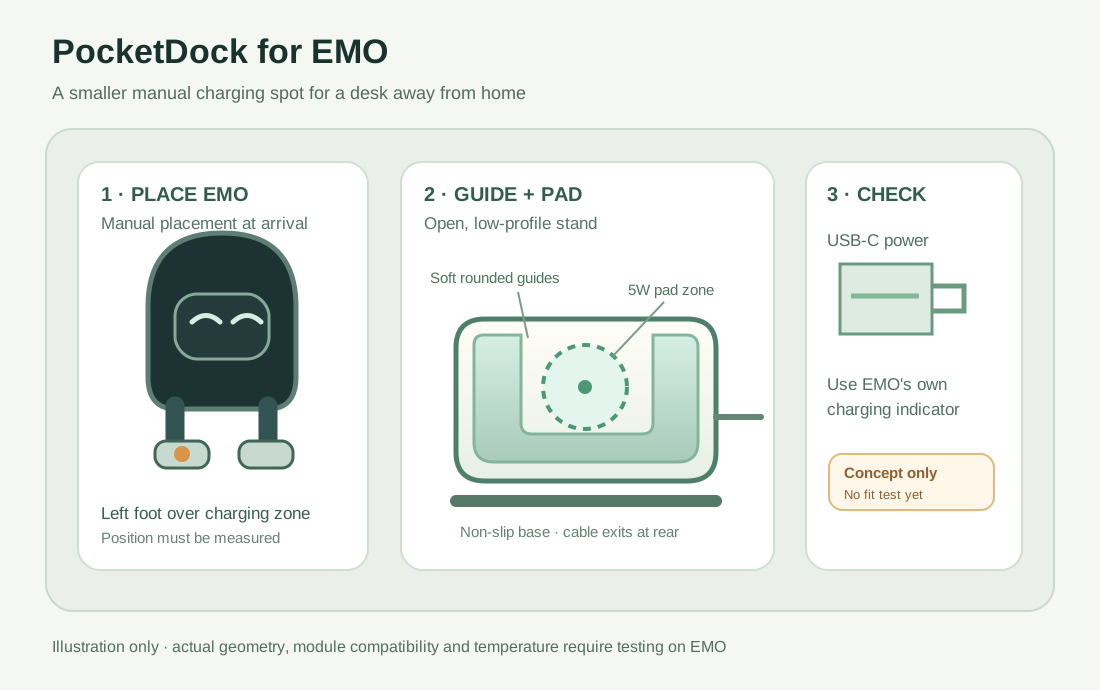
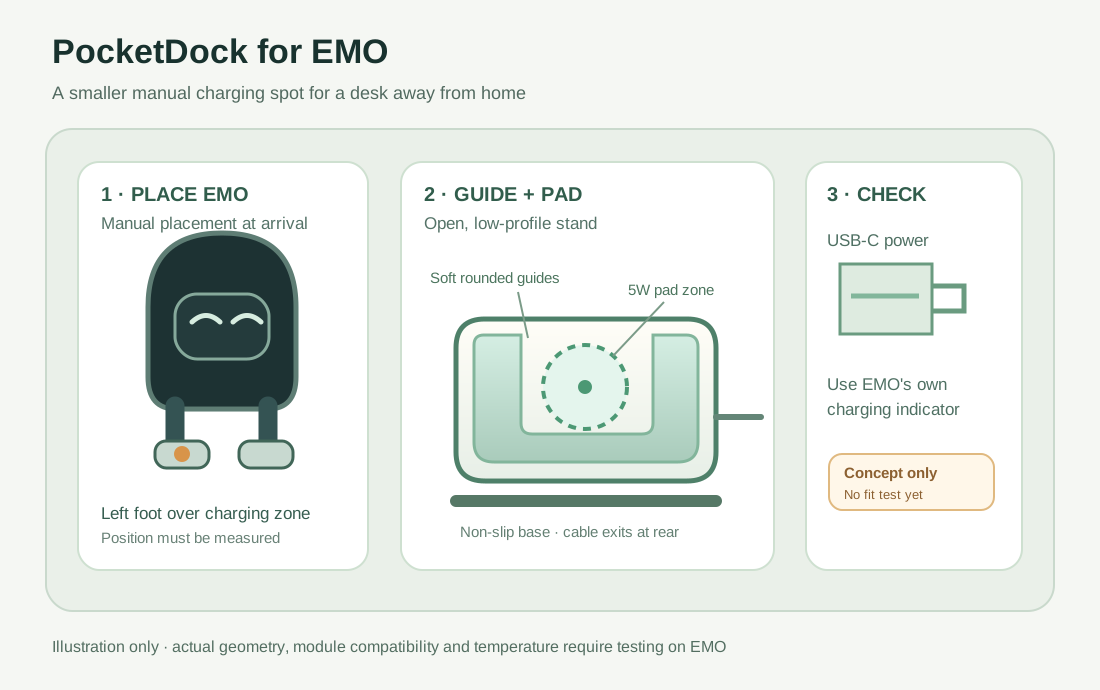
- Transport EMO in Carry Mode or powered down as appropriate, securely in its original box or another protective case. The proposed first stand is a separate accessory, not a closed charging case.
- At the destination, place PocketDock on a level desk away from an edge. Connect its vetted low-power wireless module through the rear strain-relief channel to a suitable USB power supply, then lower EMO so the left foot enters the rounded guide.
- Check charging on EMO itself. A pad-power light would show that the module has power, not necessarily that EMO is charging. Disconnect before repacking; EMO cannot locate this stand or walk home to it automatically.
Directions worth considering
Locator frame for an existing Qi pad
Benefit: Fastest mechanical prototype and avoids designing charging electronics.
Tradeoff: Pad sizes vary, the customer must supply a known compatible pad, and the value may be too small for a product.
PocketDock manual charging stand
Benefit: One vetted low-power module and shaped guide could provide a compact, repeatable place to charge at a destination.
Tradeoff: Requires real-hardware fit, charging, heat and electrical-compliance testing; cannot self-dock EMO.
Battery-powered carry-and-charge case
Benefit: Could combine transport, protection and power in one object.
Tradeoff: Introduces lithium shipping, heat, movement and weight issues; far too much complexity for the first demand test.
Our recommendation: Use a printed frame around a selected low-power pad to test placement value first. If EMO charges safely and owners prefer the guided form to a bare pad, develop the compact complete stand. Do not advance the integrated charger or any carry-case charging promise before electrical and thermal testing.
Build the first version
A small, stable open-desk stand with a removable vetted 5W Qi module, soft left-foot guides, silicone underside and USB-C lead. No integrated battery, active carry case, self-docking, play-area fence or unattended-use promise. Measure and test real EMO variants before fixing geometry.
Materials and production options
- First mechanical trials: printed PETG or PA12 shell, interchangeable pad pocket, silicone feet and soft TPU contact guides. Measure real EMO geometry and a chosen charging module before specifying any dimension.
- Possible production: molded PC/ABS or ABS base, replaceable compliant low-power charging module, molded TPE grip, USB-C lead route and accessible fasteners. No integrated battery or custom transmitter coil in the first version.
Prototype checks
- With a consented EMO Go Home, baseline official charging and physically measure left-foot receiver alignment. Bench-check several suitable low-power pads on an open, nonflammable surface; record charge confirmation, time, heat and interrupted-power behavior.
- Print an adjustable locator and test repeated placement by people unfamiliar with EMO. Compare the guided pad with an unmodified generic pad and a working skateboard, including after carrying the robot normally.
- If one design is reliably cooler and easier to place, seek electrical-compliance advice, supplier samples and packaged-cost quotes. Stop if fit, charging or temperature is inconsistent.
05 / Business assumptions
Could this support a business?
A narrowly targeted travel accessory could appeal to the subgroup that moves EMO between desks, especially owners who received only the Home Station. Yet a cheap generic pad or existing skateboard may solve the task, travel frequency is unknown, and compliant electronics and returns could erase margin. No market size or unit economics has been measured.
Price to test
$39 USD for a complete manual stand with vetted low-power module and cable is an unvalidated price question. Anker's 313 wireless pad was listed at $18.99 on its US collection page, but its compatibility with EMO has not been tested here. The official Home Station is $99 and offers more capability. Owners must see a repeatable placement benefit before a premium makes sense.
Costs still to verify
No supplier quote, bill of materials, electrical certification plan, packaging cost, return rate or support cost exists. Component prices and a subtractive gross-margin calculation would be misleading before a tested design; quote the full delivered product and compliance work first.
Where the first customers might come from
A practical HomeRobotHQ guide to charging EMO away from home could connect the EMO profile, this report and the consumer concept. Search phrases such as EMO Go Home travel charger are plausible discovery routes, not measured traffic. Talk first with owners who have actually carried EMO between locations.
06 / Next experiment
What should a builder test first?
The first decisive test: Bench-test low-power Qi pads with a consented EMO Go Home on an open surface. Record EMO's own charging confirmation, temperature and repeat placement success. Add a printed locator, then compare it with an unmodified pad and working skateboard in a blinded placement exercise with owners.
Next validation steps
- Interview Go Home owners who have taken EMO away from home, recording actual frequency, equipment carried, whether they own a skateboard, and the last charging problem they faced.
- Test a printed locator with several low-power Qi modules on real EMO units. Compare placement success, temperature and charging indication against bare pads and the official skateboard under the same conditions.
- Only after safe repeatable charging, show a clear complete-product mockup and $39 target-price question. Count signups as stated interest, then seek a stronger paid test before tooling.
What would make us drop this idea?
- No selected low-power module repeatedly charges the target EMO variants within acceptable temperature and placement limits.
- A plain generic Qi pad matches the guided stand in real-owner placement tests, or a working skateboard remains easier for most likely buyers.
- Interviews show few Go Home owners take EMO to a second location or that they are satisfied packing Home Station.
- Owners reject the $39 target after seeing the included components and alternatives, or compliance and delivered costs make the product uneconomic.
Practical risks to check before going further
- An ordinary Qi pad and careful placement may be good enough at far lower cost; a working skateboard already solves much of the problem for standard-bundle owners.
- EMO's wireless receiver, firmware behavior and temperature may differ by hardware revision. A particular third-party module may fail despite other owners' older Qi reports.
- A powered stand on an open desk is not an unattended-use or fall-prevention device. EMO could step away after power loss or be knocked over; design and copy must avoid a false safety claim.
- Electrical compliance, module sourcing, support and returns may overwhelm the economics of a small accessory. A future official compact charger could remove the gap.
Explore building this idea
Start with the prototype plan and compare it with the existing alternatives. The consumer page shows how the proposed benefit and price could be presented to owners.
Go to the prototype plan ↑View PocketDock for owners ↗07 / Sources and updates
How we reached this starting point.
Research method
Focused desk research on September 29, 2026: local September HomeRobotHQ robot snapshot, the EMO profile, current LivingAI EMO/Go Home/Home Station listings and Carry Mode notes, recent owner travel questions, and older Qi/DIY workarounds. No EMO unit, charger or temperature was tested; no owner was interviewed or contacted. Public discussions were paraphrased without copying comments, usernames or images.
Post dates below refer to the underlying evidence; checked dates show when the source was reviewed. A recent check does not make an old post recent. Individual reports do not establish market size.
Source notes
- Recent owner asks about an EMO carry-and-charge accessory ↗LivingAI owner forum · Post · Checked
An owner asked whether a carry accessory was sold and explained that taking the Home Station away from home was inconvenient. The request includes interest in a smaller portable charging method. One self-selected owner account within a longer historical thread; neither prevalence nor willingness to pay is known.
- Owner describes original-box and skateboard workaround ↗LivingAI owner forum · Post · Checked
The owner said they had carried EMO in its box with its skateboard, but the skateboard stopped working. The reply displayed three likes when checked. Same owner and thread as the preceding source; this is one experience, not independent corroboration or a verified charger fault diagnosis.
- Separate recent question about the Carry Mode bag ↗LivingAI owner forum · Post · Checked
A separate participant asked about the bag shown in EMO Carry Mode material. Demonstrates carrying-accessory interest, not specifically demand for a charging stand; no engagement count was visible on that question.
- Official EMO Go Home listing ↗LivingAI · Checked
The current $369 package is presented with the larger Home Station, automatic return and Home Fence. Manufacturer listing does not state installed base or prove the absence of all other travel chargers.
- Official standard EMO listing ↗LivingAI · Checked
The current $279 standard package lists a skateboard charger with cable. The offer may change; it does not show what equipment an individual Go Home owner also owns.
- Official Home Station listing ↗LivingAI · Checked
Home Station is sold separately for $99 and includes self-return functionality after firmware setup. It is a more capable product than a manual travel stand; price is only a reference, not a direct like-for-like benchmark.
- LivingAI announces Carry Mode ↗LivingAI · Post · Checked
Firmware 2.8.0 introduced Carry Mode to unload EMO's servos during transport, via voice command or app. Carry Mode is a transport behavior, not a compact charger or proof of safe charging in a bag.
- Historical Qi charging alternative ↗LivingAI owner forum · Post · Checked
Owners discussed using low-power Qi charging for EMO Go Home by placing the left foot over a pad. Historical peer advice, not manufacturer certification or current validation of any particular module or hardware revision.
- Historical DIY charging carrier proposal ↗LivingAI owner forum · Post · Checked
A participant proposed printing a carrier that would hold the original skateboard and a battery. An intention to build, not a finished or tested DIY product; historical context only.
- Historical box and skateboard travel arrangement ↗LivingAI owner forum · Post · Checked
An owner described using a small box, the skateboard and a power source while traveling. One historical account; equipment and current owner routines may differ.
- HomeRobotHQ EMO profile ↗HomeRobotHQ · Checked
The indexed profile supplies EMO model and ownership context for this robot-specific opportunity. Editorial context, not independent evidence of travel frequency or accessory demand.
- Owner asks about carrying EMO or AIBI ↗LivingAI owner forum · Post · Checked
The original question asks about secure transport for EMO or AIBI and displayed five likes. The author mentions two different robots; this does not establish charger demand or a count of EMO owners.
- Generic wireless pad retail comparison ↗Anker · Checked
Anker's US wireless-pad collection listed the 313 Wireless Charger (Pad) for $18.99. It represents a lower-price generic alternative. Price and availability may change. This pad was not tested with EMO and must not be presented as compatible or safe for this robot.
Report updates
- : Initial unpublished research. Distinguished the recent travel-and-charging need from historical DIY context and current official charging bundles; electrical compatibility and demand remain open.