01 / The opportunity
Why might someone buy this?
The potential reason to pay is a tidy, easy-to-assemble space that fits the charger, permits interaction and is easier to clean than an improvised tray. It must offer enough benefit over a cheap household tray to justify its price and desk space.
Who might need it?
- Primary: EMO owners who use a desk, shelf or side table and want a defined play space without building one themselves.
- Secondary: prospective EMO buyers planning a charging area. Compatibility with other robots is untested and is not claimed.
EMO is designed to move on a tabletop. LivingAI describes edge detection, but an August 2026 owner account reports repeated falls beyond the Home Station mat while using the latest firmware. That owner had tried a cardboard box but found it poorly suited to a small desk.
The 2026 account supports current relevance, while older discussions show that trays and fences have been improvised for years. None of these reports establishes a defect rate. The practical question is whether a compact physical perimeter can help without disrupting movement or docking.
02 / Existing solutions
How owners handle it today.
| Current solution | What it does | What remains |
|---|---|---|
| LivingAI Home Station mat ↗ | Provides a marked surface and a place for the optional charging station. The station was listed at $99 when checked. | The mat is not a mechanical barrier; owner reports describe movement beyond it in some setups. |
| Household trays ↗ | A breakfast or plastic tray adds an inexpensive physical edge. | Size, grip and cable routing vary. Owners may need to drill a cable opening or improvise charger placement. |
| DIY barriers ↗ | Wood, cardboard or printed fences can be shaped for an individual desk. A 2026 owner described taping wood around the play space. | Durability, attachment, size and appearance depend on the individual build. A different 2026 owner found a cardboard box cramped on a small desk. |
What a better product would need to do
- A continuous physical perimeter with secure, accessible entry.
- A stable, non-slip base large enough for the charger and movement area.
- Footprint options for smaller desks, rather than assuming a single 50 cm base fits everyone.
- Cable routing that does not modify EMO or its power supply.
- Measured compatibility with both Home Station and skateboard charger configurations.
03 / Research evidence
How strong is the evidence?
Opportunity type: Explicit owner problem + observed DIY workarounds
Three selected forum posts from April, May and August 2026 describe a wood barrier, a request for a physical border and falls beyond the mat. They support investigating the need, but do not establish how common it is or willingness to pay.
Recent 2026 owner posts describe falls, improvised barriers and a request for a physical safety border. LivingAI still sells a Home Station with a virtual fence, rather than a physical wall. Older DIY examples show the problem's history.
A purpose-built enclosure may save setup work and organize the charging area better than improvised trays.
How many owners need it, whether they prefer it to a cheap tray, what dimensions work, and whether they would pay for it.
Selected evidence
Recent owner report: falls beyond the mat ↗
An owner reported repeated desk falls after EMO left the Home Station mat, stated it had current firmware, and said a cardboard box did not fit a small desk well.
Post: · Checked: One self-reported setup; the cause and effect of any later fix are unverified.Recent request for a physical Home Station border ↗
One participant proposed adding a physical safety barrier to the existing play mat; the discussion was reopened for Home Station suggestions.
Post: · Checked: A single feature request shows interest, not purchasing intent or a proven barrier height.Recent DIY wood enclosure ↗
An owner described taping wood around EMO's play space; a forum reply recommended an enclosed area during unattended tabletop use.
Post: · Checked: A single improvised build; safety and compatibility were not independently tested.Posts dated April, May and August 2026 show the issue and interest in physical barriers remain current. Older DIY builds provide context. These are qualitative signals, not EMO unit sales, a problem rate or evidence that owners would buy this enclosure.
Search interestNo verified keyword volume or Google Trends result was available for this concept when researched. Search Console and a named keyword source should be checked after publishing; ranking and traffic are not assumed.
04 / Product design
How the product could work.
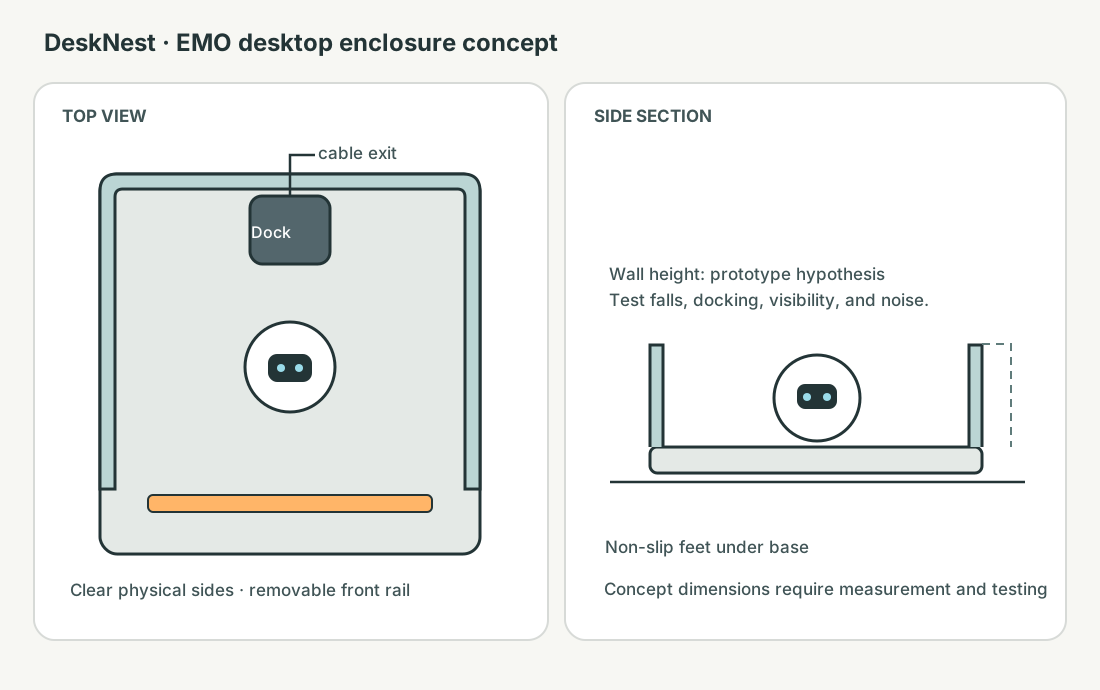
- Place a flat, matte, non-slip base on a sufficiently large desk. An outer size near 50 × 50 cm is only an initial design hypothesis; the Home Station mat has been reported by owners at about 43.4 × 43.4 cm and must be measured directly.
- Fit clear side panels around the walking area, route the existing charging cable through a protected rear opening, and keep the original charger inside.
- Remove the front panel to clean the area or pick EMO up. Panel height, locks, reflections and docking must be validated with real hardware before any safety claim.
Directions worth considering
Desk-edge guard
Benefit: Small package and minimal desk coverage.
Tradeoff: Fit depends on desk thickness and edge shape; each side needs protection.
Solid four-sided tray
Benefit: A simple, complete physical perimeter.
Tradeoff: Bulky, visually heavy and harder to access.
DeskNest modular enclosure
Benefit: Clear sides, removable front, planned charger space and cable exit.
Tradeoff: More parts and cost; reflections and docking behavior need testing.
Our recommendation: Prototype the modular enclosure first. Its value would be an EMO-specific, tidy setup rather than the mere existence of a barrier. A cheap tray remains the benchmark it must beat.
Build the first version
Build an adjustable matte base with simple side panels and a removable front. Reserve space for the existing charger. Leave out decorative parts and custom molds until footprint, movement and docking have been checked.
Materials and production options
- Prototype: CNC-cut HDPE or polypropylene base, laser-cut polycarbonate walls, printed PETG joints, soft TPE edge strips and silicone feet.
- Possible production: molded or thermoformed base, flat-pack wall panels and molded corner joints. These are manufacturing hypotheses, not supplier quotes.
Prototype checks
- Measure real EMO chargers and mats, then make an adjustable low-cost prototype before fixing dimensions.
- Test walking, dancing, charging and return-to-dock with both charger types on several desk finishes.
- Check whether reflections confuse EMO and whether the entire enclosure can slide. Begin movement tests on the floor or a protected surface.
05 / Business assumptions
Could this support a business?
The initial hypothesis is a small accessory line for EMO owners, potentially sold as a flat-pack kit. Desk-space constraints and shipping volume may limit the opportunity. Actual packed dimensions, supplier quotes and owner preferences are needed before estimating margin or sales potential.
Price to test
$49 is a landing-page question, not a validated selling price. A $39–$69 range could be tested after prototype feedback.
Costs still to verify
No supplier quote or reliable unit-cost estimate exists. Before judging the $49 hypothesis, price base and wall fabrication, flat-pack packaging, freight, storage, returns, fees and customer acquisition.
Where the first customers might come from
Reach owners researching EMO desk setups through a useful guide linked from the robot profile. Later, owner-approved demonstrations or specialist robot retailers could help recruit prototype testers. Community participation must follow its rules; there is no verified acquisition cost or retailer commitment.
Why this belongs on HomeRobotHQ
This idea adds a practical desk-setup investigation to the EMO profile: existing trays, charging layouts and the tradeoffs of a proposed physical enclosure. It is relevant to both current owners arranging their desks and makers exploring EMO accessories. See the EMO profile for robot context.
06 / Next experiment
What should a builder test first?
The first decisive test: Compare the prototype with an inexpensive tray on a protected surface. Check movement, docking, sliding and access, then ask owners which setup they prefer at the proposed $49 price.
Next validation steps
- Show the concept and $49 price question to EMO owners; ask which charger they use, desk size, current solution and prior falls.
- Treat a waitlist signup as interest, not a purchase. Compare signup behavior with interviews and prototype preference against a normal tray.
- Before tooling, complete physical compatibility, stability, edge and material tests plus a basic intellectual-property review.
What would make us drop this idea?
- Owners consistently prefer a low-cost tray after seeing and trying the prototype.
- EMO cannot move and dock reliably inside a practical enclosure size.
- Qualified visitors see the proposed price but rarely join the waitlist or report a need.
Practical risks to check before going further
- Many owners may prefer an inexpensive tray or find the official mat adequate.
- A roughly 50 cm base may be too large for common desks.
- A wall can still be climbed or pushed, and higher sides could interfere with interaction.
- Reflections, surface finish and cable placement may alter movement or docking.
- Shipping volume and dependence on one robot model may undermine the economics.
- LivingAI could introduce its own physical barrier; a May 2026 owner requested one in a Home Station improvement discussion.
Explore building this idea
Start with the prototype plan and compare it with the existing alternatives. The consumer page shows how the proposed benefit and price could be presented to owners.
Go to the prototype plan ↑View DeskNest for owners ↗07 / Sources and updates
How we reached this starting point.
Research method
Research using selected owner discussions and current manufacturer product pages. Recent posts are separated from historical DIY context. The concept has not been built, tested with EMO or validated through owner interviews.
Post dates below refer to the underlying evidence; checked dates show when the source was reviewed. A recent check does not make an old post recent. Individual reports do not establish market size.
Source notes
- Recent owner report: falls beyond the mat ↗LivingAI owner forum · Post · Checked
An owner reported repeated desk falls after EMO left the Home Station mat, stated it had current firmware, and said a cardboard box did not fit a small desk well. One self-reported setup; the cause and effect of any later fix are unverified.
- Recent request for a physical Home Station border ↗LivingAI owner forum · Post · Checked
One participant proposed adding a physical safety barrier to the existing play mat; the discussion was reopened for Home Station suggestions. A single feature request shows interest, not purchasing intent or a proven barrier height.
- Recent DIY wood enclosure ↗LivingAI owner forum · Post · Checked
An owner described taping wood around EMO's play space; a forum reply recommended an enclosed area during unattended tabletop use. A single improvised build; safety and compatibility were not independently tested.
- Home Station listing ↗LivingAI · Checked
Official charging-station accessory listed at $99 when checked. Price can change and does not imply demand for DeskNest.
- Earlier tray and cable-routing examples ↗LivingAI owner forum · Checked
Earlier posts show a plastic tray and improvised charger cable routing. Historical DIY context, not fresh evidence of current demand.
- Earlier fall reports ↗LivingAI owner forum · Post · Checked
The discussion began in 2023 with owner reports of falls, cardboard barriers and breakfast trays. Historical, self-reported cases; no denominator for frequency.
- EMO product information ↗LivingAI · Checked
Manufacturer describes tabletop motion and edge sensing. Manufacturer description does not establish fall prevention in every environment.
Report updates
- : Rechecked the April, May and August 2026 owner posts and current Home Station listing; added a builder overview, commercial assumptions and a clearer first test. No hardware results were added.