
01 / The opportunity
Why might someone buy this?
The reason to buy would be a fitted, prewired input with a clear setup routine. A bare sensor is inexpensive, and software may cost nothing. The kit must save setup effort or improve usable detection enough to justify the extra cable and price.
Who might need it?
- Reachy Mini Lite owners who want to explore touch-triggered greetings or custom app inputs.
- Makers who can run a host-computer app but prefer not to wire and package raw sensors.
- Not intended as a ready-made upgrade for every conversation app, a child-safety product, collision detector or repair for faulty movement.
An owner who wants physical interaction has several routes, but no verified ready-fit version of this specific single-zone kit was identified in the focused search.
Software can infer a pat from robot movement. Direct sensing instead measures pressure at a defined spot, which may help separate contact from ordinary motion. That distinction does not establish superior performance.
LOOMIA's demonstration is an observed hardware experiment. The removable carrier, simplified single-zone kit and release-first routine below are our proposed design, not components claimed to have been built by those demonstrators.
02 / Existing solutions
How owners handle it today.
| Current solution | What it does | What remains |
|---|---|---|
| Try software-only pat detection ↗ | The current community CLI lists a pat interaction and a runtime that combines sensing and motion without an added touch patch. | A July issue describes detection during motion as a difficulty in that project's setup. Test the current version first: if it serves the task reliably, added hardware may have little value. |
| Assemble a sensor demonstration ↗ | LOOMIA's public experiment combines flexible sensing and a Python-controlled robot response. It shows a concrete activity rather than just a wish for one. | It does not establish a fitted consumer kit, repeatable installation or compatibility with the current Lite. A simplified packaged version must earn its convenience advantage. |
| Use existing antenna interactions ↗ | Official app documentation describes antenna-touch startup behavior and points developers to antenna-based inputs. | This may be sufficient for a simple trigger. It does not establish a dedicated contact point on the head or automatic compatibility with arbitrary apps. |
What a better product would need to do
- Use one marked sensing zone and contact/release events. Do not promise whole-head sensing, stroke direction or calibrated force measurement.
- Map the actual Lite shell and microphone openings before choosing a mount; preserve the camera, antennas, ventilation, shell finish and full moving-part envelope.
- Route an external flexible lead with enough slack and a removable strain-relief point. Stop if a safe unobstructed route cannot be demonstrated.
- Use a separate USB controller on the host computer; keep the robot's original power and USB connection unchanged.
- Provide calibration, a clear stop control and a logging mode. The first interactive routine waits for release before commanding a small response.
- Document app compatibility and software versions. Do not run a second independent motion controller beside an active robot app.
03 / Research evidence
How strong is the evidence?
Opportunity type: Observed maker activity / accessory improvement hypothesis
LOOMIA demonstrated an added touch sensor in November 2025. A July 2026 community project documents both software-only pat sensing and difficulties separating contact from motion. Its older calibration issue is closed, so it is not proof that current software fails. These are maker experiments, not a representative owner survey.
A public sensor demonstration shows this interaction has been explored. Current official documentation supports custom apps and antenna-touch startup behavior. Community software also offers pat sensing without a separate sensor. None of those sources validates TouchLeaf.
A direct contact signal could be easier to configure than interpreting motion, and a removable prewired kit could be more convenient than assembling a sensor experiment. These are reasons to compare prototypes, not measured advantages.
Current software performance on the intended Lite revision, a suitable unobstructed patch location, reliable gentle-contact thresholds, cable routing, owner preference, delivered-price acceptance and support cost.
Selected evidence
LOOMIA touch experiment curated by the robot maker ↗
The dated LOOMIA entry describes flexible sensing and a Python-driven robot response. It displays nine likes. The demonstration establishes an activity; the proposed kit was not used.
Post: · Checked: Historical demonstration within the past year, manufacturer-curated and not a buyer survey. Later reposts are the same experiment; hardware revision and full build details are not established.Current software-only pat interaction ↗
The README lists a pat command and a combined sensing runtime. It also describes control-ownership constraints.
Checked: Third-party project, not official Pollen support or a benchmark we reproduced. Exact current-version behavior must be tested on the intended Lite.A recent direct-versus-inferred sensing discussion ↗
The open issue discusses limits of pose-based pat detection during movement and proposes reading actuator data instead.
Post: · Checked: Project-reported findings on its setup, not universal robot behavior. It is a software development proposal, not evidence that an external patch is necessary or that every hardware revision shares its driver.The strongest signal is a demonstrated maker activity plus a recent independent software project pursuing the same interaction. The curated November demonstration entry displays nine likes; this is a small engagement signal, not traffic or purchase demand. Community size, a representative owner sample and willingness to pay are unknown. Reposts of the same demonstration are not additional independent experiments.
Search interestNo reliable keyword-volume data, Search Console export or reproducible Google Trends series was available. Reachy Mini touch sensor, pat detection and interaction projects are plausible specific intents for useful content, not measured traffic forecasts.
04 / Product design
How the product could work.
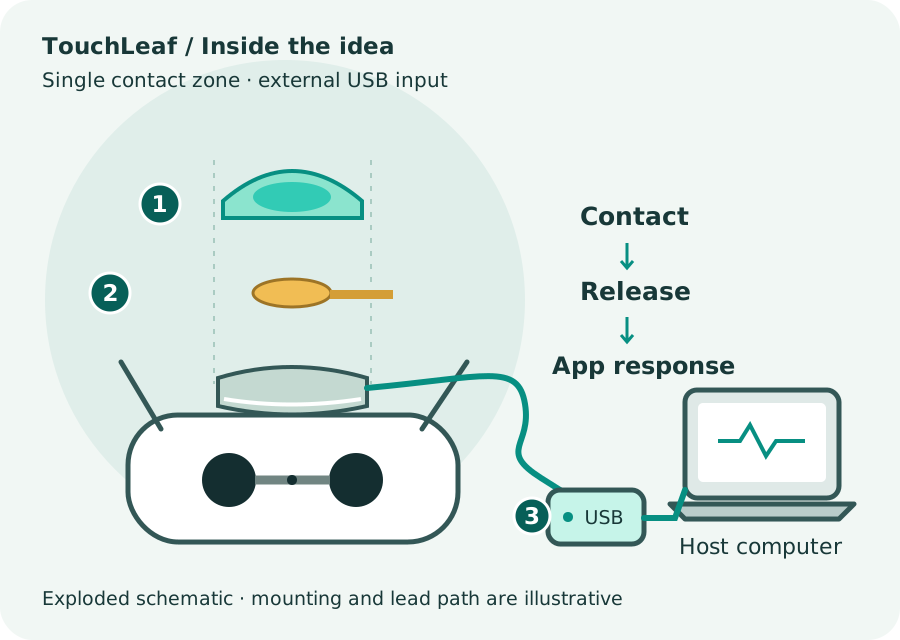
- 1 / Compliant contact padA small marked spot transfers gentle pressure. Its shape and force threshold require testing.
- 2 / Sensor and removable carrierOne sensing zone in a shell-mounted carrier. Position is schematic until microphones and motion clearance are measured.
- 3 / Controller and starter appThe external controller connects to the Lite host computer. The app reads contact and release before triggering a response.
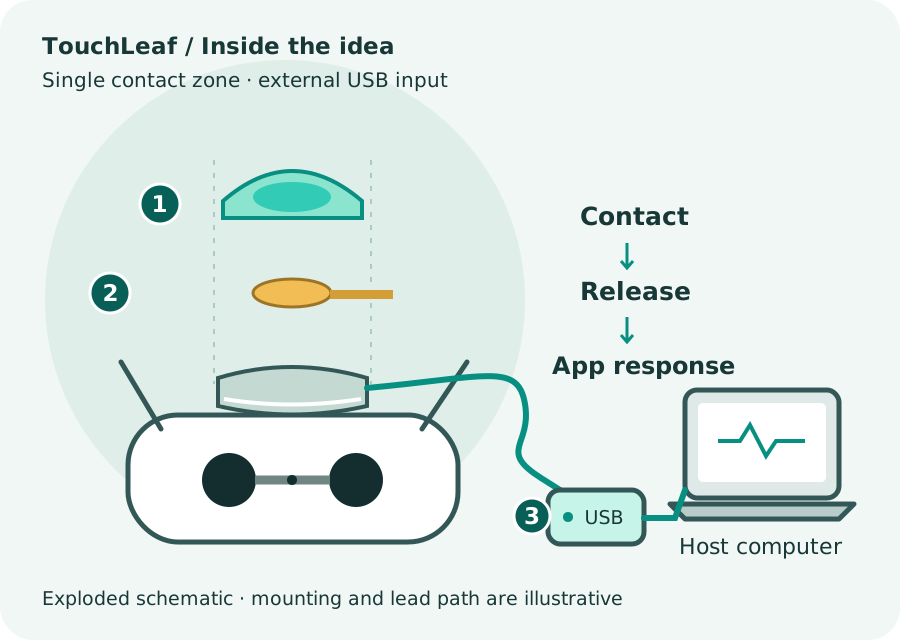
- 1 / Compliant contact padA small marked spot transfers gentle pressure. Its shape and force threshold require testing.
- 2 / Sensor and removable carrierOne sensing zone in a shell-mounted carrier. Position is schematic until microphones and motion clearance are measured.
- 3 / Controller and starter appThe external controller connects to the Lite host computer. The app reads contact and release before triggering a response.
- A compliant pad sits over a single force-sensitive resistor supported by a small carrier. Contact changes resistance; a microcontroller reads a voltage-divider signal and reports contact/release over USB. This is an event detector, not a precision force instrument.
- The carrier would attach reversibly to a measured shell area using a suitable removable mounting layer. Test finish compatibility and removal first. It must not cover microphones or constrain antennas; no screw hole or factory connector is assumed.
- A flexible external lead runs behind the head to an enclosed controller on the desk, with a slack loop and removable strain relief. Full head and body motion require clearance testing before powered use.
- The starter app runs on the Lite's host computer and owns the intended interaction. It calibrates an unloaded baseline, rejects brief noise and waits for release before a bounded response. Integration into another app is separate development.
Directions worth considering
Removable single-zone pressure patch
Benefit: Creates a direct contact event with inexpensive component candidates and a narrowly scoped first experience.
Tradeoff: Requires light pressure, calibration, a cable and a fit check. A poorly supported pad can preload the sensor or make owners press too hard.
Capacitive touch overlay
Benefit: Could detect finger contact without deliberate pressure and suit a thin removable surface.
Tradeoff: Electrode placement, grounding, false triggers and material sensitivity need a separate investigation. No equivalent fitted Reachy kit was verified in this research.
Separate desktop interaction button
Benefit: Avoids loading the robot's head and makes wiring simple.
Tradeoff: A generic USB button may already be enough, and pressing a desk button changes the desired robot-touch experience. Use it as a low-complexity comparison.
Our recommendation: Prototype the single-zone pressure patch as a direct input, starting with a stationary head and contact logging. Keep the free software method as the first comparison. Continue only if direct sensing or easier setup adds a benefit owners actually value.
Build the first version
One single-zone force-sensitive resistor under a small compliant contact pad; a removable shell carrier; a flexible lead with strain relief; an enclosed USB microcontroller; and a starter app that calibrates contact/release and plays a bounded response after the hand is removed. The controller plugs into the Lite host computer, not an undocumented robot connector. No internal robot wiring or soldering by the owner is proposed.
Materials and production options
- Compare a thin silicone contact cap with a compliant TPU pad over a flat sensor support. Do not assume a larger soft surface will activate a small sensor evenly.
- Use a replaceable FSR with a clamp-style connection; the supplier warns that careless direct soldering can damage its plastic tail. Protect that tail with strain relief.
- Print the initial carrier and controller enclosure in PETG, then evaluate molded parts only after a repeatable mounting and sensing arrangement exists.
- Use an enclosed USB microcontroller with an analog input and a replaceable flexible lead. Obtain supplier documentation and electrical review before any production design; no custom power connection into the robot is proposed.
Prototype checks
- Obtain an identified Lite revision and record its firmware, host system and SDK version. Measure the intended shell patch area and microphone openings; compare current software-only pat sensing before designing hardware.
- Bench-test the sensor off the robot, with no actuator commands. Compare unloaded drift, contact detection and release under candidate pads. Reject configurations that need a firm push or remain triggered after release.
- Check an unpowered removable carrier mockup for fit, finish marks and cable routing. No dimension in the illustration is a fabrication specification.
- Run contact logging with the robot stationary, then with supervised bounded movement and no touch-triggered movement. Compare false events and missed contacts with the software baseline under the same conditions.
- Only after clearance and detection pass, add a small response after release. Test stop behavior, USB disconnection and app restart; loss of sensor data must not trigger movement.
- Repeat installation/removal and ordinary motion with the lead attached. If routing catches, rubs, pulls the head or obstructs sensing, redesign or stop before inviting owners to try it.
05 / Business assumptions
Could this support a business?
Test interest in a $49 USD kit for existing maker owners. The value would be the carrier, wiring, calibration and maintained integration. A $3.95 sensor price is not a complete production cost. Support across software versions could cost more than the electronics, and a good free solution could make the kit unnecessary.
Price to test
Would an existing Lite owner consider $49 USD for the assembled patch, lead, controller and starter app? This is a proposed price question. Compare delivered price and setup effort with free software and a self-built sensor before estimating willingness to pay.
Costs still to verify
No production quote or complete unit-cost estimate is available. A current Adafruit round FSR is listed at $3.95; LOOMIA's nine-cell evaluation matrix is listed at $95 and is not the proposed single-zone BOM. Neither price includes our carrier, controller, lead, assembly, calibration, packaging, fulfillment, fees, returns or software support. Quote those separately before assessing margin.
Where the first customers might come from
Reachy Mini project builders are the first audience to test. Useful content could demonstrate direct sensing versus software-only detection and a beginner interaction project. The robot profile, maker search queries and relevant project communities are possible discovery paths; no audience size or partnership is established.
06 / Next experiment
What should a builder test first?
The first decisive test: On a measured Lite, compare the patch with current software-only pat detection and a bare sensor on a simple test mount. Record missed contacts, false events during untouched motion, setup time and cable interference. Start with the head stationary and a logging-only app; add a response only after release.
Next validation steps
- First compare direct sensing, the current software method and a basic bare-sensor setup on one documented Lite. Keep contact logging separate from motion until the mechanical and detection checks pass.
- After the bench gate, a proposed six-owner exploratory trial can compare setup completion, missed contacts, unintended events and which interaction people choose to repeat. Six is a usability-study plan, not a statistically representative demand sample.
- Show the concept page to relevant Lite owners and separate existing owners from prospective buyers. Ask the $49 question and what they would make; waitlist responses measure stated interest, not sales.
- If owners only need a simple trigger and antenna input or a desktop button does it just as well, provide a software guide instead of developing this kit.
What would make us drop this idea?
- Current software-only sensing performs adequately and owners prefer avoiding an extra cable.
- A gentle repeatable signal cannot be achieved without unacceptable head pressure or false triggers.
- No removable shell location and lead route preserve normal movement and sensing.
- Owners enjoy a demonstration but do not repeat the interaction or value the assembled kit over raw parts.
- Quoted production plus software-support costs cannot support a price the intended owners will consider.
Practical risks to check before going further
- A sensor pad may need more pressure than is appropriate on a moving head, or react to mounting preload rather than intended contact.
- An external lead can snag, affect movement or make the robot less appealing to use. Patch location and microphone clearance remain unverified.
- Current software or existing antenna inputs may already satisfy owners at no additional hardware cost.
- The starter app and other apps may compete for control; integration and ongoing version support are essential parts of the product.
- A single sensing zone may feel less natural than owners expect from a petting demonstration. Do not imply whole-head touch or emotion recognition.
- Electrical, small-part and mechanical product requirements need review before sale. This is a supervised maker accessory concept, not a safety sensor.
Explore building this idea
Start with the prototype plan and compare it with the existing alternatives. The consumer page shows how the proposed benefit and price could be presented to owners.
Go to the prototype plan ↑View TouchLeaf for owners ↗07 / Sources
Sources behind this idea.
Post dates show when the underlying evidence appeared; checked dates show when the source was reviewed.
- LOOMIA touch experiment curated by the robot maker ↗Pollen Robotics community showcase / LOOMIA demonstration · Post · Checked
The dated LOOMIA entry describes flexible sensing and a Python-driven robot response. It displays nine likes. The demonstration establishes an activity; the proposed kit was not used. Historical demonstration within the past year, manufacturer-curated and not a buyer survey. Later reposts are the same experiment; hardware revision and full build details are not established.
- Sensor maker's description of the experiment ↗LOOMIA / LinkedIn · Checked
The sensor maker identifies a Mini Matrix in a force-based Reachy interaction experiment. The retrieved relative date was inconsistent with the dated showcase, so no absolute publication date is assigned here. This is related demonstration context, not independent demand evidence.
- Current software-only pat interaction ↗Community Reachy Mini CLI project · Checked
The README lists a pat command and a combined sensing runtime. It also describes control-ownership constraints. Third-party project, not official Pollen support or a benchmark we reproduced. Exact current-version behavior must be tested on the intended Lite.
- A recent direct-versus-inferred sensing discussion ↗Community Reachy Mini CLI issue tracker · Post · Checked
The open issue discusses limits of pose-based pat detection during movement and proposes reading actuator data instead. Project-reported findings on its setup, not universal robot behavior. It is a software development proposal, not evidence that an external patch is necessary or that every hardware revision shares its driver.
- Official app lifecycle and antenna interactions ↗Pollen Robotics / Hugging Face documentation · Checked
Documents managed apps, one active app at a time and optional antenna-touch startup behavior. It also points to developer interaction patterns. Undated current documentation; not a guarantee of accessory integration or behavior on every installed firmware version.
- Reachy Mini Lite hardware and host connection ↗Pollen Robotics / Hugging Face documentation · Checked
Documents a computer-connected robot with moving head, body and antennas, a camera and microphone array. USB is a host interface, not a charging input. Overall specifications do not locate a safe patch mount or verify an external cable route. Actual hardware revision must be measured.
- Single-zone component candidate ↗Adafruit · Checked
The Alpha round FSR is listed at $3.95, with a 0.3–10 N stated sensitivity range. The listing describes analog response, variation between sensors and delicate connections. A component specification, not a safe contact-force recommendation for Reachy Mini or proof that the assembled pad detects a gentle touch.
- Existing multi-zone sensor alternative ↗LOOMIA · Checked
Lists a nine-cell evaluation matrix at $95. It is a development component rather than a complete Reachy accessory. Availability text is ambiguous in the retrieved page. Its price is not a quote for the proposed single-zone kit; no stock or volume-cost claim is made.
- Current official Lite offer ↗Pollen Robotics · Checked
The store offers the Lite for developers with an external host computer. The US browser view displays $399 USD and a lead time of up to 90 days. An orderable robot with demonstrated use, not guaranteed immediate stock or a measured installed base. Regional web retrieval displayed EUR pricing separately.
- Earlier calibration issue is closed ↗Community Reachy Mini CLI issue tracker · Post · Checked
The issue describes a calibration problem and appears closed, linking to #83. The linked resolution could not be retrieved. Its original symptoms must not be presented as unresolved behavior in today's release.