
01 / The opportunity
Why might someone buy this?
The proposed advantage is less gathering and storing of miscellaneous objects, plus layouts that are easy to repeat or change. Attractive panels alone are a weak reason to pay. The kit must earn its place against free boxes and generic play blocks.
Who might need it?
- Current Eilik plus Panxer owners who enjoy driving, hiding and rearranging a play space.
- Households or hobby groups that can reserve a clear indoor floor and pack scenery away between sessions.
- Poor fit for standalone Eilik owners, people satisfied with open-floor play, or owners expecting autonomous new games or software improvements.
The job is arranging a physical play space and returning the room to ordinary use. The accessory does not repair the robot or compensate for unreliable software.
A layout needs enough open space to steer and turn. More walls are not automatically more fun: clutter could obstruct play, hide the robot from the owner or create avoidable collisions.
No folding-arena DIY example was found. The connected folding modules, cards and sleeve are an original design proposal here, not a design attributed to owners.
02 / Existing solutions
How owners handle it today.
| Current solution | What it does | What remains |
|---|---|---|
| Use the existing play modes on an open floor ↗ | The maker offers floor-driving and battle activities without requiring this kit. | There is no prepared scenery to shape routes. That may be preferable to some owners, so an open floor must remain a test baseline. |
| Arrange cover from available objects ↗ | The manufacturer explicitly encourages owners to design their own battlefield. Ordinary boxes are a low-cost way to test that approach. | The maker establishes the activity, not an owner complaint or a specific observed box build. The supposed gathering and storage burden must be measured, not assumed. |
| Use generic cardboard play blocks ↗ | Melissa & Doug offers a 24-piece set that provides a ready-made construction alternative; the retrieved price is $35.99. | It is not a verified Panxer accessory, and no owner use was found. Compare its actual storage, stability and play value before claiming a folding kit is better. |
What a better product would need to do
- Make a layout worth using compared with an open floor, boxes and suitable generic blocks. Compare setup, cleanup and voluntary reuse.
- Keep driving gaps wider than the measured swept envelope of the assembled robot, including its turning and turret motion.
- Provide self-supporting returns without rigid loose connectors or sharp corners. Do not rely on the robot to hold scenery upright.
- Test battle-cover behavior with actual hardware before choosing panel height, surface and material. Appearance alone does not establish signal blocking.
- Fold into a manageable sleeve repeatedly. Check crease fatigue, dirt, sliding and whether packing is actually easier than storing boxes.
03 / Research evidence
How strong is the evidence?
Opportunity type: Latent need: a reusable play and storage accessory for an existing robot activity.
Current manufacturer material establishes the play activity. A recent independent discussion confirms ownership of Eilik with Panxer, but does not complain about scenery, setup or storage. No owner-built folding arena or recurring demand for one was found. The evidence supports exploring a use case, not claiming an unmet mass-market need.
Panxer is a current Eilik accessory, and its manufacturer presents custom cover layouts as part of play. A September 2026 discussion includes an owner of the combination. Generic cardboard play blocks are an available alternative.
A compact, reusable set could help an owner repeat or change layouts without gathering miscellaneous objects each time. This is an interpretation of the activity, not an owner-reported inconvenience.
How often owners build layouts; whether setup or storage bothers them; whether they prefer an open floor; whether proposed panels improve repeat play; exact clearances, material behavior and willingness to pay.
Selected evidence
Current Panxer offer and play activities ↗
Current listing offers Panxer for Eilik at $119.90 USD and displays 16 reviews. It presents owner-designed cover layouts and requires current Eilik firmware before assembly.
Checked: Undated manufacturer marketing, not independent play research. Reviews are not sales; review dates were unavailable. Published dimensions do not verify assembled clearance or proposed scenery performance.Recent ownership context ↗
A comment indexed as September 27 mentions owning Eilik with Panxer. The parent discussion began in June and concerns custom code.
Post: · Checked: Ownership only: no scenery complaint, purchase intent or frequency of use. The parent was readable; the direct comment endpoint was unavailable and the live view used a relative date. This is not evidence of a recurring need.Generic construction-block alternative ↗
A current 24-piece cardboard block set is listed at $35.99, providing a generic construction alternative to compare.
Checked: No Panxer compatibility or owner adoption established. Price excludes any destination-specific costs; no purchase or hands-on storage comparison performed.The current Panxer listing displays 16 reviews; individual review dates and Panxer owner population were not established. The recent Reddit ownership mention is about another topic, not a request for scenery. Neither review count nor thread engagement proves interest in FoldQuest.
Search interestNo dependable search-volume data, accessible Search Console export or reproducible Google Trends series was obtained. Eilik Panxer arena, Panxer game ideas and Eilik Panxer accessories are proposed discovery queries, not measured traffic. A genuinely useful layout comparison could serve that narrow intent.
04 / Product design
How the product could work.
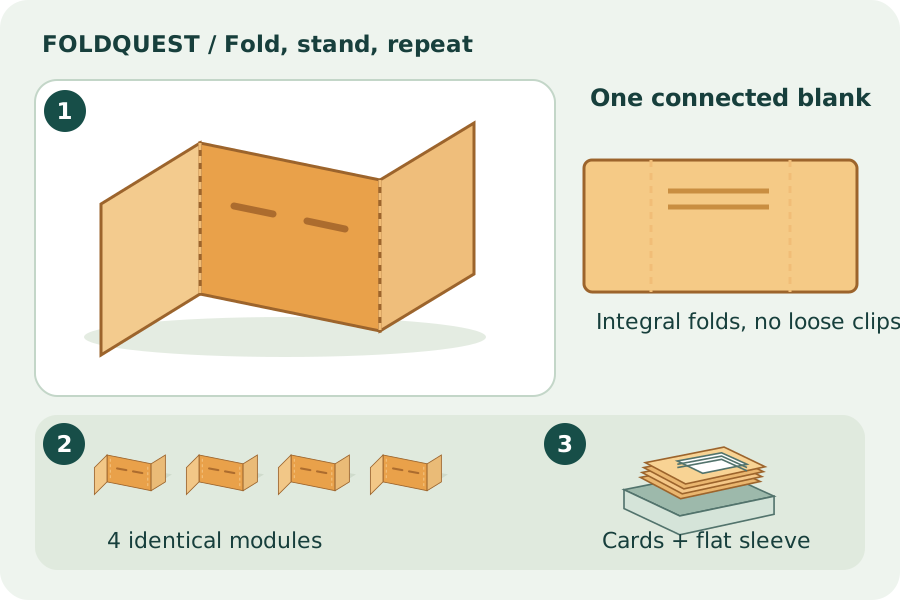
- 1 / One connected moduleTwo return wings support the central panel. Integral folds avoid loose connectors; proportions are schematic.
- 2 / Four modules, many arrangementsRepeat the same part around open floor routes. Measure real driving and turning clearances before fixing panel size.
- 3 / Pack flatStack the modules with three layout cards in one sleeve. Fold life and storage thickness need measurement.
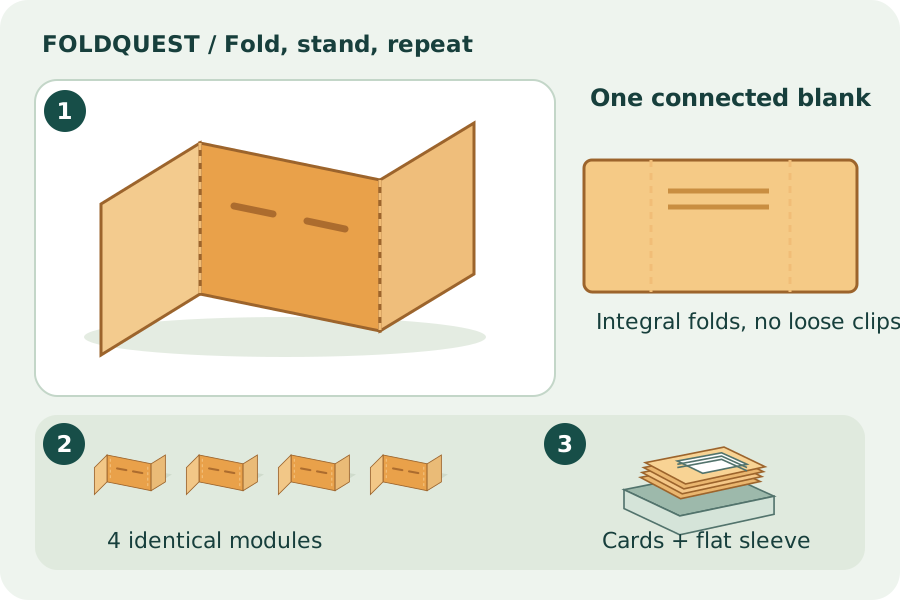
- 1 / One connected moduleTwo return wings support the central panel. Integral folds avoid loose connectors; proportions are schematic.
- 2 / Four modules, many arrangementsRepeat the same part around open floor routes. Measure real driving and turning clearances before fixing panel size.
- 3 / Pack flatStack the modules with three layout cards in one sleeve. Fold life and storage thickness need measurement.
- Each wall starts as one sheet with a central face and two connected return wings. Folding the wings out creates a footprint that resists ordinary movement better than a single upright sheet; actual stability remains a test.
- Place four modules around wide, open floor routes. The owner steers using the existing controller. Cards suggest arrangements rather than software missions or scoring rules.
- The walls are proposed scenery and potential cover. Panel opacity to a human eye does not verify battle-signal behavior. Test direct and angled shots, reflections and the robot's receiving geometry before making a cover claim.
- Fold the return wings inward after play and stack the modules in a sleeve with the cards. No part stays attached to Eilik or Panxer.
Directions worth considering
Printable layouts and cardboard cutting templates
Benefit: A cheap way to test whether arranged scenery improves play at all, using available materials.
Tradeoff: Owners must source and cut material; inconsistent builds complicate durability and storage. This could still be the best solution if a manufactured kit adds little.
FoldQuest folding wall kit
Benefit: A small reusable set offers repeatable layouts and compact storage with no robot attachment.
Tradeoff: Fold lines, stability and useful play geometry need testing. Paying for prepared panels must beat using free boxes.
Interlocking rigid or foam scenery
Benefit: Could create more elaborate structures and support more shapes.
Tradeoff: Bulkier storage and more parts may undermine the intended quick routine. Avoid adding height or climbable obstacles before basic floor play is validated.
Our recommendation: Test the folding walls against simple boxes first. Keep cards and artwork modest until owners voluntarily choose to set the kit up again. If ordinary boxes deliver the same routine, publish useful layout instructions rather than manufacture a weak accessory.
Build the first version
Four identical three-leaf wall modules with rounded corners and integral fold lines. Return wings make each module freestanding; there are no loose connectors. Include three layout cards and a flat sleeve. Keep the first version on the floor with wide routes, without ramps, arches, electrical parts or attachments to Panxer.
Materials and production options
- Start with rounded corrugated-cardboard blanks and taped fabric hinges on a bench prototype. Keep cut edges and tape away from moving tracks; compare against ordinary boxes before improving the finish.
- Compare die-cut coated board with thin corrugated polypropylene or solid polypropylene hinge samples. These are candidate materials, not confirmed battle-cover materials or a bill of materials.
- Evaluate a single-sheet folded construction before adding fasteners. If a living hinge is appropriate, its thickness, grain or flute direction, radius and fatigue behavior must be determined with the chosen supplier.
- Use printed card for layouts and a sewn fabric or folded board sleeve. Quote cutting, print, hinge production, finishing, inspection, packaging and shipping after defining the actual folded dimensions.
Prototype checks
- Acquire or borrow an Eilik/Panxer combination with the manufacturer's current supported setup. Follow its firmware and assembly instructions; do not modify the robot.
- Measure the assembled height and swept width during turning and turret motion. The published Panxer dimensions are only a reference and do not verify a complete arena clearance envelope.
- Make oversized adjustable cardboard panels first. Compare wide layouts, open floor and ordinary boxes; trim only after observing clearances. Do not begin with precise unverified dimensions from an illustration.
- Test stability, sliding and contact at low speed in a controlled floor area. Stop if panels catch a track, topple onto the robot or make routine driving frustrating.
- Check direct and oblique battle interactions with each candidate material, including reflections around edges. Reject the cover claim if results are inconsistent; separately evaluate whether driving-route scenery still has value.
- Record setup and packing time, stored volume and crease condition over repeated sessions. An initial 30 fold cycles is a proposed screening exercise, not a durability certification.
05 / Business assumptions
Could this support a business?
This is a small accessory for a subset of Eilik owners who also bought Panxer. The $29 question tests a modest kit, not a verified selling price. A thin parcel might help fulfillment, but actual folded dimensions, packaging, manufacturing and delivered margin are unknown. Do not estimate revenue from the wider Eilik audience.
Price to test
Would a current Panxer owner consider $29 USD for four modules, three cards and a sleeve? This is a proposed price to test. The generic block set's $35.99 listing is context, not proof of value or willingness to pay for this smaller kit.
Costs still to verify
No measured BOM or supplier quotation exists. Price board/plastic cutting, hinge construction, printing, sleeve assembly, inspection, flat protective packaging, freight, fulfillment, fees and returns. Request small-batch and repeat-run quotes after a successful mockup. Do not infer margin from raw sheet cost.
Where the first customers might come from
Start with useful Eilik/Panxer setup and play-layout content linked from the Eilik profile. A later demonstration could show the same floor arranged with boxes and the kit. Owner communities, hobby groups and maker channels are possible distribution routes; traffic, partnerships and conversion are not established.
06 / Next experiment
What should a builder test first?
The first decisive test: On actual Eilik/Panxer hardware, compare a few large cardboard mockups with an open floor and ordinary boxes. Can owners create and clear a useful layout more conveniently, and do the walls remain stable without restricting movement or producing confusing battle behavior?
Next validation steps
- First validate the mechanism on hardware; do not recruit owners into a scene that can catch tracks or topple onto the robot.
- Then, with later consent, compare three setups among a small exploratory group of current Panxer owners: open floor, boxes, and folding mockups. Vary the order, ask them to set up and pack away each, and observe their preferred repeat setup.
- A proposed initial group of six owners can expose usability problems but cannot estimate market prevalence. Define success before the sessions: a clear practical advantage and voluntary reuse, not compliments about an animation.
- Use the concept waitlist to distinguish people who actually own Panxer from interested Eilik-only owners, and ask about current scenery and $29. Review qualifying interest separately from total clicks.
- If owners want layouts but not hardware, test a printable guide before manufacturing. If evidence remains weak, stop the product direction without treating page traffic as demand.
What would make us drop this idea?
- Owners do not choose the arranged space over open-floor play after the first demonstration.
- Free boxes or generic blocks match the useful routine without a meaningful storage disadvantage.
- Safe, stable geometry cannot coexist with comfortable driving gaps in realistic rooms.
- Material tests cannot deliver consistent cover, and route-only scenery is not valued.
- Owners who prefer the kit still would not consider the delivered price, or production and fulfillment cannot support that price.
Practical risks to check before going further
- Owners may seldom use Panxer, or may prefer open-floor play without setup.
- Boxes or existing play blocks may be equally convenient and more versatile.
- Panels can slide, tip, catch tracks or create cramped routes. They are not collision protection or containment.
- Surface finish and room reflections may make battle cover unreliable even when a panel looks opaque.
- Large enough panels may be awkward to ship; compact ones may be too small to improve play. Repeated folds may split or curl.
- A paid kit can become a novelty with little repeat use. Child-use materials, edges and product suitability require appropriate development review before sale.
Explore building this idea
Start with the prototype plan and compare it with the existing alternatives. The consumer page shows how the proposed benefit and price could be presented to owners.
Go to the prototype plan ↑View FoldQuest for owners ↗07 / Sources
Sources behind this idea.
Post dates show when the underlying evidence appeared; checked dates show when the source was reviewed.
- Current Panxer offer and play activities ↗Energize Lab · Checked
Current listing offers Panxer for Eilik at $119.90 USD and displays 16 reviews. It presents owner-designed cover layouts and requires current Eilik firmware before assembly. Undated manufacturer marketing, not independent play research. Reviews are not sales; review dates were unavailable. Published dimensions do not verify assembled clearance or proposed scenery performance.
- Recent ownership context ↗Public r/Eilik discussion · Post · Checked
A comment indexed as September 27 mentions owning Eilik with Panxer. The parent discussion began in June and concerns custom code. Ownership only: no scenery complaint, purchase intent or frequency of use. The parent was readable; the direct comment endpoint was unavailable and the live view used a relative date. This is not evidence of a recurring need.
- Generic construction-block alternative ↗Melissa & Doug · Checked
A current 24-piece cardboard block set is listed at $35.99, providing a generic construction alternative to compare. No Panxer compatibility or owner adoption established. Price excludes any destination-specific costs; no purchase or hands-on storage comparison performed.
- Eilik profile and existing robot context ↗HomeRobotHQ · Checked
Eilik is the indexed robot from which this accessory idea starts. An editorial profile does not establish the Panxer installed base or demand for a play kit.