
01 / The opportunity
Why might someone buy this?
The potential paid value is a correctly matched, finished spare with clear fitting guidance, when getting an original part is inconvenient. Printing a complete decorative headset is a different purchase and requires more work.
Who might need it?
- Owners of the original standard headphone set with a missing upper clip and undamaged mating seat.
- Repairers who can identify the headset revision and fit a small mechanical spare.
- Not a solution for broken headbands, failed ear lights, voice recognition or damaged attachment seats.
This is a narrowly defined missing-part problem. The affected owner wants to restore an existing accessory, rather than add a new interaction to the robot.
A viable seller must distinguish the upper band clips from the ear-cup rings and light covers. Confusing those pieces would create wrong orders and misleading repair advice.
Firmware is not a remedy for a missing physical part. However, current hardware revisions and support policies can change whether an aftermarket spare is needed.
No completed DIY replacement for this exact top clip was found. The product directions below are proposed designs, rather than methods already demonstrated by owners.
02 / Existing solutions
How owners handle it today.
| Current solution | What it does | What remains |
|---|---|---|
| Ask support or source a complete donor pair ↗ | The recent forum reply points toward manufacturer support or a privately available headset. An original spare would be the strongest fit comparator. | The reply does not confirm that individual clips can be supplied, or establish a price or turnaround. Check this before investing in a replacement SKU. |
| Cover the gap or reattach a retained piece ↗ | Stickers were suggested in the recent exchange; historical replies suggest glue when a detached piece is still available. These are suggestions, not demonstrated successful repairs. | A cover does not reproduce the molded part; reattachment cannot recover a lost piece. Adhesive compatibility and installation quality are unverified. |
| Print a different complete headphone design ↗ | A maker sells a downloadable decorative EMO headphone design for $4 USD. It offers another appearance for people with access to printing. | It replaces the overall style and requires fabrication and assembly. It is not a verified replacement for the original top clips or lighting assembly. |
What a better product would need to do
- Identify one specific original headphone revision with close-up fit photographs and a clear left/right parts guide.
- Match the existing band seat without forcing it, covering the head’s sensing areas or changing how the headphones attach to EMO.
- Use a removable retention geometry that survives ordinary handling. Do not claim a stronger part until compared with the original.
- Supply finished, deburred parts; keep them secure on a labeled card during delivery and storage. Small loose parts require adult handling away from children and pets.
- Demonstrate a practical advantage over obtaining a genuine spare. If that option is equally easy and cheaper, the aftermarket offer loses its rationale.
03 / Research evidence
How strong is the evidence?
Opportunity type: Explicit missing-part request / niche repair opportunity
A September 2026 owner request identifies the missing top-band piece. The public evidence is isolated; it does not establish frequency or willingness to pay. A historical teardown helps locate the component, but no current unit has been measured and direct support availability is unresolved.
The current EMO package includes standard headphones. A September 20, 2026 owner request seeks a missing blue top-band piece; a historical teardown describes separate left/right top clamps.
A finished, correctly identified spare could be more convenient than sourcing an entire headset or undertaking a full decorative print. The value would come from compatibility and availability.
How often these parts go missing, whether support supplies them, the clip geometry across revisions, retention loads and willingness to pay a delivered price.
Selected evidence
Recent request for the missing blue top-band piece ↗
An owner requests a replacement or printable model. The reference image marks the upper band clips.
Post: · Checked: An isolated request, not evidence of a common failure. The supplied picture identifies the intended part; it is not a measurement or a photo of the damaged unit.Historical headphone construction reference ↗
The teardown lists separate left/right top clamps and warns that removing them can break them.
Post: · Checked: Historical construction context. It does not establish current dimensions, a universal revision fit or safe disassembly instructions for every headset.Current official EMO package ↗
The $279 package includes the standard headphones; official imagery shows the two upper blue band accents.
Checked: Current orderability establishes a relevant robot, not installed base or demand for this spare. Shipping, tax and regional offers can differ.The recent request establishes that this missing-part task exists. Its thread showed 658 views and eight likes across posts dating back to 2022 when checked; those totals cannot be assigned to the September request, converted to affected owners or used as purchase demand. The creator listing displayed zero downloads at this check, which supplies no positive sales evidence.
Search interestFocused searches found a specific owner request, historical headset construction and decorative accessory listings. No reliable keyword volume, reproducible Google Trends series or Search Console export was available. Organic discovery is a hypothesis to test with exact part-identification queries, not a traffic forecast.
04 / Product design
How the product could work.
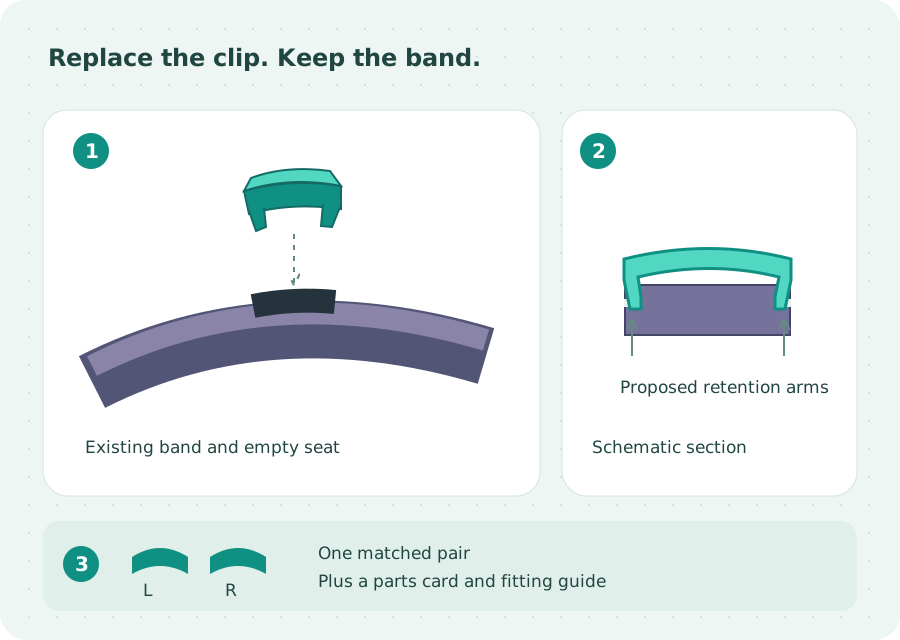
- 1 · Replace the top clipProposed finished part for an intact original band; ear-cup rings stay unchanged.
- 2 · Match the seatMeasure the existing interface before designing the catch. Section shown schematically.
- 3 · Supply a labeled pairLeft and right parts plus identification and fitting guidance.
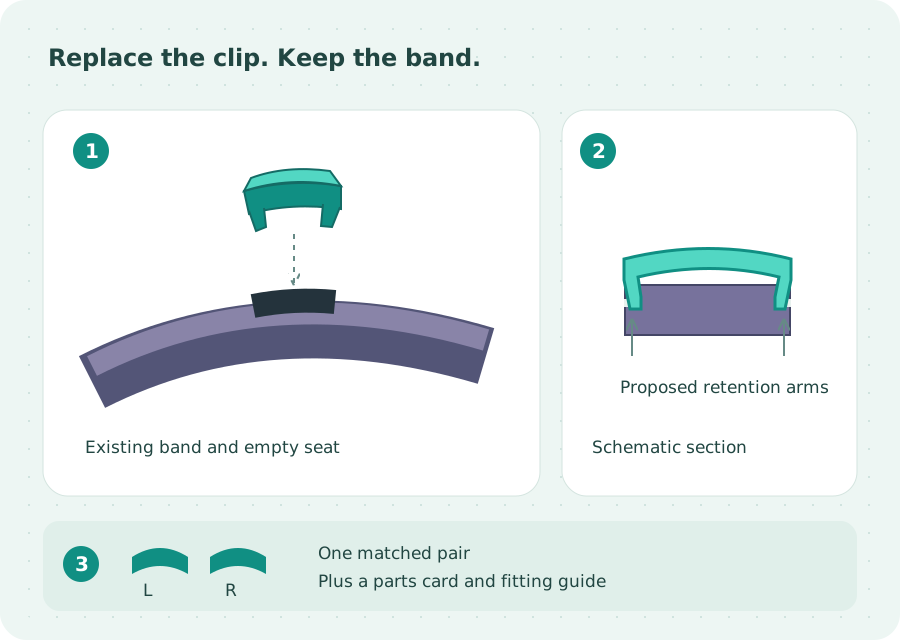
- 1 · Replace the top clipProposed finished part for an intact original band; ear-cup rings stay unchanged.
- 2 · Match the seatMeasure the existing interface before designing the catch. Section shown schematically.
- 3 · Supply a labeled pairLeft and right parts plus identification and fitting guidance.
- Identify the headset and the missing part using close-up photos. The original band and its mating seat must be intact; a broken seat needs a different repair.
- Support the detached headphone band according to a verified handling procedure. Orient the correct replacement to the existing seat and fit it without loading EMO’s head or forcing the band.
- A proposed pair of flexible retention features holds the clip against the measured seat. The exact catch geometry is a prototype decision, not a verified reproduction of the original.
- Check seating, removal and normal headphone attachment on the robot. No wires, lights or software are added or changed.
Directions worth considering
Matched replacement clips — recommended
Benefit: Addresses the specific missing item while keeping the existing headset. Small batches allow revision-by-revision learning.
Tradeoff: Tiny mating features and left/right differences require real measurements and inspection; the addressable audience may be very small.
Flexible wrap-around band collars
Benefit: Could span an intact band without relying on the original clip catches.
Tradeoff: Adds visible bulk and may shift or collect dirt. It changes the appearance and requires a new retention comparison.
Complete replacement headband assembly
Benefit: Could address more extensive band damage and include new clips together.
Tradeoff: Adds interfaces, assembly work and a larger cost. It would compete more directly with original donor headphones and existing decorative prints.
Our recommendation: Prototype the matched left/right clip pair for an intact original band. Its job is to replace a missing part with minimal change. Do not expand into a full headset or claim to repair damaged band seats until the small spare proves useful.
Build the first version
One left/right pair for one measured headphone revision, supplied on a labeled card with a fit photo and installation guide. Start with an independently modeled replacement profile and compliant retention features; no lights, adhesives, color range or replacement headband.
Materials and production options
- For fit trials, compare fine-feature PA12 printing with a tougher resin sample from a qualified print service. Inspect flexible catches and surface finish; brittle decorative resin is not automatically suitable.
- Use a soft prototype fixture to support the band during measurements. The product itself should not require a bulky jig or an adhesive repair.
- For later batches, evaluate nylon printing versus molded engineering plastic only after the geometry and order volume justify tooling. Use a simple paperboard parts card and protective mailer; obtain real packaging and shipping quotes.
Prototype checks
- Document one original headphone revision using measurements and photos of an intact clip, empty seat and internal clearance. Do not pry off the only good clip simply to copy it; use a spare assembly and appropriate handling.
- Model an independent replacement profile with several catch-clearance variants. Test on the detached band first. Reject any version requiring force, showing stress whitening or leaving a loose fit.
- Compare the chosen sample with an original through repeated fitting, removal and ordinary supervised handling. Record cracks, looseness and interference with normal headset seating; do not test by dropping EMO.
- Try clear identification and installation instructions with owners unfamiliar with the prototype. Track wrong-side selection and failed fits before adding more headset versions.
05 / Business assumptions
Could this support a business?
Treat this as a made-to-order or small-batch repair SKU, possibly within a broader robot spare-parts shop. Its narrow audience and low order value make standalone advertising and international shipping difficult. A successful clip does not by itself establish a substantial business.
Price to test
The first consumer question is $12 USD per finished left/right pair, plus explicitly disclosed delivery. This is a proposed price, not a market estimate or validated willingness to pay. The $4 decorative-headphone download is a lower-priced digital alternative, not a delivered equivalent. Obtain an original-spare quote before choosing a final price.
Costs still to verify
No manufacturing quote or measured part volume exists. Cost is therefore unestimated. Request quotes for a small sample batch and a larger repeat batch, including printing, finishing, fit inspection, rejects, labeling, packaging and fulfillment. Evaluate payment fees, delivery, support and replacements before deciding whether a $12 item can support a business.
Where the first customers might come from
Reach owners searching for the exact missing part through a useful illustrated identification guide and a model-specific product page. Repair shops and permitted community demonstrations are possible discovery channels; their reach and conversion remain unknown.
06 / Next experiment
What should a builder test first?
The first decisive test: Measure an intact clip and empty seat on a consented original headphone set. Compare a finished replacement with the remaining original for fit, removal effort and retention. In parallel, establish whether manufacturer support already supplies an equivalent spare conveniently.
Next validation steps
- Establish original-spare availability, price and delivery from manufacturer support or documented owner outcomes before spending on tooling.
- Invite owners with the exact missing component to a consented fit trial. Verify hardware revision rather than counting general EMO fans as qualified demand.
- Test the replacement against an intact original. Record installation effort, retention, damage and rework on each measured assembly. Set acceptance criteria from the original before testing prototypes.
- Show a working sample and the full delivered price to those owners. Separate general interest from choosing this spare over an available genuine part.
- Use the concept form to learn the missing component and support experience. Signups are stated interest; production spending would need stronger evidence.
What would make us drop this idea?
- Support consistently supplies the exact original clip with less effort and a lower delivered price.
- A replacement cannot hold securely without damaging the band or obstructing normal headphone attachment.
- Owners with the actual missing piece prefer leaving the gap or replacing the headset and show little interest after seeing the delivered price.
- Revision identification and support costs make small orders uneconomic, even when printing is inexpensive.
Practical risks to check before going further
- The original manufacturer may already provide the clip cheaply or free through support, eliminating most of the convenience advantage.
- Small brittle catches could break or damage the original band. A visually similar print may still have incorrect geometry.
- Parts may vary between headset revisions. A universal-fit promise would create avoidable returns.
- The need may be rare, and delivery or support could cost more than the product. A mail-order spare is not automatically a scalable business.
- Loose parts can be lost or ingested; this is an adult-fitted repair component, not a play accessory.
Explore building this idea
Start with the prototype plan and compare it with the existing alternatives. The consumer page shows how the proposed benefit and price could be presented to owners.
Go to the prototype plan ↑View BandMend for owners ↗07 / Sources
Sources behind this idea.
Post dates show when the underlying evidence appeared; checked dates show when the source was reviewed.
- Recent request for the missing blue top-band piece ↗LivingAI owner forum · Post · Checked
An owner requests a replacement or printable model. The reference image marks the upper band clips. An isolated request, not evidence of a common failure. The supplied picture identifies the intended part; it is not a measurement or a photo of the damaged unit.
- Suggested ways to obtain or cover a missing part ↗LivingAI community reply · Post · Checked
The reply suggests support, another headset or stickers. Earlier posts in the same thread discuss reattachment. Advice, not a completed repair or an official spare-parts policy. The recent request and reply are the same discussion, not independent corroboration.
- Historical headphone construction reference ↗LivingAI community teardown · Post · Checked
The teardown lists separate left/right top clamps and warns that removing them can break them. Historical construction context. It does not establish current dimensions, a universal revision fit or safe disassembly instructions for every headset.
- Current official EMO package ↗LivingAI · Checked
The $279 package includes the standard headphones; official imagery shows the two upper blue band accents. Current orderability establishes a relevant robot, not installed base or demand for this spare. Shipping, tax and regional offers can differ.
- Existing decorative printed-headphone alternative ↗Independent designer listing on Thangs · Checked
A $4 USD downloadable complete decorative headset design requires printing and glue assembly. The page displayed zero downloads. Not an original top-clip replacement. Listing age is relative; no absolute release date verified. Downloads are not sales or market size.
- Current official accessory catalog ↗LivingAI · Checked
The retrieved EMO catalog lists robots, Home Station, lights and clothes; a separate top clip was not listed. Absence from the public catalog does not establish that support cannot provide the part.