
01 / The opportunity
Why might someone buy this?
A ready-fit, removable hitch and a cart with low rolling resistance could save owners from inventing an attachment. The product needs to encourage repeat play beyond the enjoyment of ordinary RC driving.
Who might need it?
- LOOI owners who already use or want to try its documented RC mode.
- Hobbyists interested in a short indoor delivery game with paper messages or light play tokens.
- Poor fit for unattended use, household hauling, tabletop edge protection, or owners who only want better conversation.
The opportunity is to expand physical play. The documented request concerns a rear cart; a small delivery game is our proposed use for it.
A trailer adds resistance and occupies space the original robot was not designed to sense. An accessory that interferes with motion would undermine the activity it is meant to create.
No LOOI trailer DIY was found in the focused search. The adapter, captive swivel and lightweight cart are original design directions, not a user design reproduced here.
02 / Existing solutions
How owners handle it today.
| Current solution | What it does | What remains |
|---|---|---|
| Drive the unmodified robot using RC LOOI ↗ | The official support page describes direct movement control after syncing a phone. This is the lowest-cost baseline and needs no extra hardware. | It provides driving, not a verified cargo attachment. The trailer must make the activity worth repeating compared with ordinary driving. |
| Ask the manufacturer for an accessory ↗ | The maker acknowledged the cart suggestion and said it had been shared with its product team. | That response is not a launch commitment. The current catalog retrieved lists the robot, without a separately listed cart. No owner use of a released official trailer was established. |
What a better product would need to do
- Fit a measured L-01 without using the USB port, phone magnet, sensor windows or moving neck as a structural anchor. Reject the body adapter if no suitable contact area exists.
- Keep the cart light and rolling resistance low; establish a permissible operating range before claiming any payload.
- Allow smooth yaw at the drawbar, with a captive joint and a tool-free separation method. A release feature needs measured force testing and is not a safety certification.
- Keep the robot and cart on a broad, clear floor route. Do not claim that the robot senses the cart envelope or can reverse it safely.
- Make attachment and removal simple enough that owners will remove it for charging and autonomous roaming.
03 / Research evidence
How strong is the evidence?
Opportunity type: Owner-requested accessory / play hypothesis
The specific cart request is one December 13, 2025 owner review, acknowledged by the maker on December 16. It is within the last year but not a recurring complaint. The current store does not list a trailer in the catalog retrieved. No working owner-built LOOI cart, towing specification or independent demand estimate was found.
A dated owner review requests a rear cart; the maker acknowledges the suggestion. Official support describes RC LOOI control, and the robot remains listed for sale. These establish a request and a possible activity, not towing approval.
Adding a small cart could make manual driving more purposeful for some owners. A removable adapter and freely rolling wheels could make setup easier than an improvised attachment. These are design hypotheses.
Suitable body contact areas, allowed towing force, current RC stop and movement behavior, safe turning envelope, useful load, repeat use, willingness to pay and the size of the reachable owner audience.
Selected evidence
Owner request for a rear cart and manufacturer response ↗
The owner requests a rear cart. The maker replies on December 16 that the suggestion was passed to its product team. Read on the company review page, page 2.
Post: · Checked: An isolated request; its prevalence and willingness to pay are unknown. The response does not establish a prototype or planned launch.Current official description of RC LOOI ↗
Support describes syncing a phone and then controlling base movement through RC LOOI with the phone aside.
Post: · Checked: Documents a control mode, not towing support, an accessory interface or behavior with a trailer. Current app behavior must be verified on hardware.Current official catalog ↗
The retrieved catalog shows one product listing, LOOI Robot from $239. No separately listed cart appears.
Checked: A focused store check, not proof that no reseller, unreleased product or unindexed design exists. Price is robot context, not the proposed accessory price.The reviewed evidence contains an isolated cart request and a manufacturer acknowledgement. It supports exploring the activity, but the number of interested owners, repeat use and willingness to pay remain unknown.
Search interestNo reliable search-volume dataset or reproducible Google Trends series was obtained. LOOI accessories, LOOI RC play and LOOI trailer are possible content intents to test, not measured opportunities. The specific request is more useful than broad robotics-growth claims, but still cannot size a market.
04 / Product design
How the product could work.
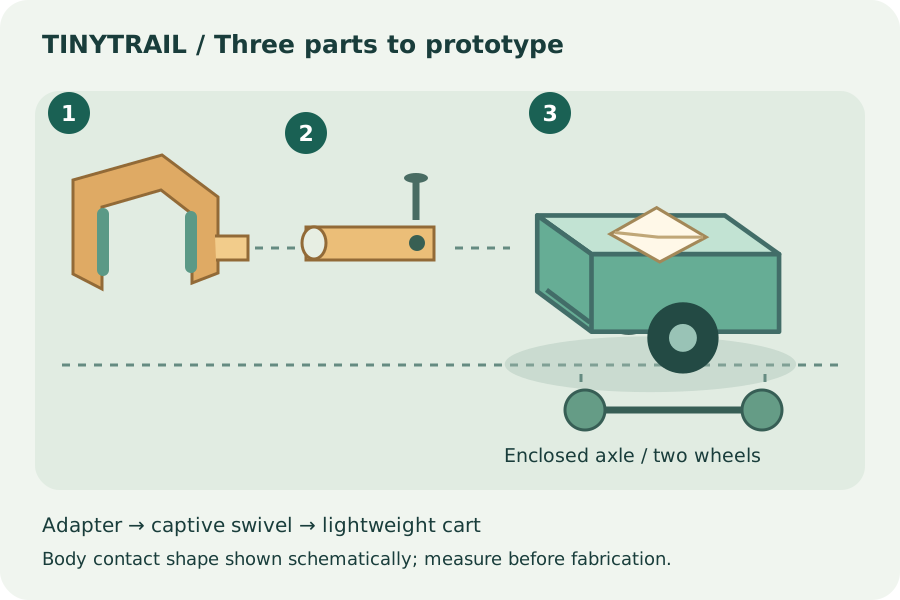
- 1 / Removable body adapterSoft contact pads and a broad shell interface are proposed. The actual contact area must be measured and kept clear of sensors and moving parts.
- 2 / Captive swivelA low drawbar allows yaw while retaining its pivot. Separation force and turning limits require bench testing.
- 3 / Wheels carry the loadAn enclosed axle supports a shallow cart. Begin with the empty cart; no payload rating has been established.
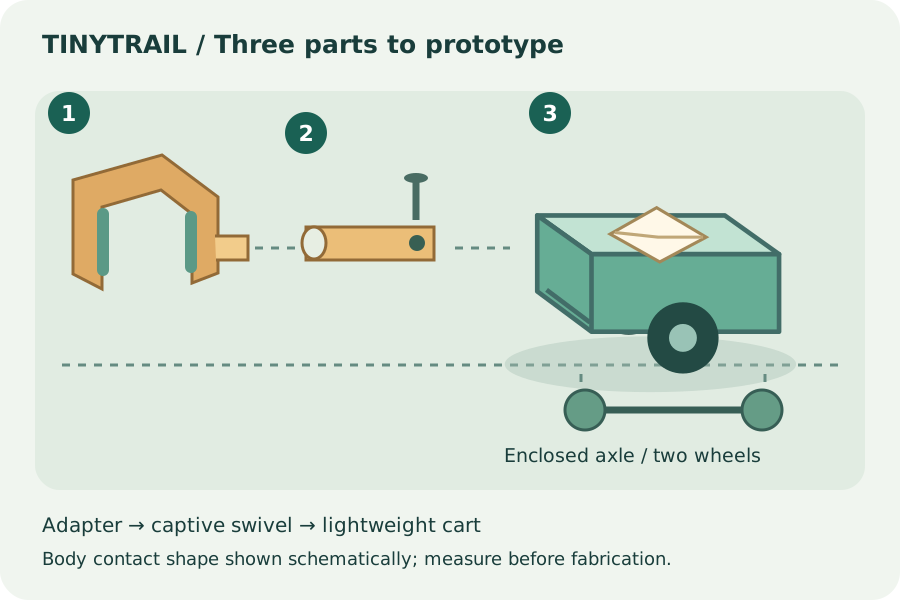
- 1 / Removable body adapterSoft contact pads and a broad shell interface are proposed. The actual contact area must be measured and kept clear of sensors and moving parts.
- 2 / Captive swivelA low drawbar allows yaw while retaining its pivot. Separation force and turning limits require bench testing.
- 3 / Wheels carry the loadAn enclosed axle supports a shallow cart. Begin with the empty cart; no payload rating has been established.
- A removable soft-lined yoke would contact a measured portion of the stationary body. It must stay clear of the tracks, side touch areas, underside sensors, neck and port. The drawing deliberately leaves the contact geometry schematic.
- A low drawbar connects the yoke to a lightweight cart through a captive swivel. The joint allows the cart to follow a broad turn; reverse motion and tight spins are excluded from the initial trial.
- Two enclosed wheels support the cart rather than hanging its load from the robot. Initial tests use an empty tray. Only after a successful mechanical baseline should a builder try a paper message or similarly light item.
- The owner controls the route using the documented RC mode. The trailer introduces no destination recognition, obstacle-map extension or automatic delivery. Detach the kit for charging and ordinary roaming.
Directions worth considering
Passive two-wheel cart with removable body adapter
Benefit: Separates cargo weight from the robot and offers a simple physical play activity without new software.
Tradeoff: Adds towing resistance, a longer swept path and an unverified mounting interface. Empty-cart and turning tests come first.
Small body-mounted cargo tray
Benefit: Avoids a trailing axle and jackknifing.
Tradeoff: Puts payload directly on the robot, competes with the moving phone plate and changes balance. Not the preferred first prototype.
Freestanding delivery targets with no attachment
Benefit: Lets owners try a destination-based driving game without putting loads on the robot.
Tradeoff: Does not carry objects, and ordinary paper markers may already be sufficient. Use this as a cheap play-value comparison, not a second accessory to manufacture by default.
Our recommendation: Start with an empty two-wheel cart and an adjustable, soft-lined adapter on a real unit. Validate mechanical feasibility before testing owner enthusiasm. If driving between paper targets is just as enjoyable, there may be no reason to sell a cart.
Build the first version
One shallow cart with two enclosed wheels and a low drawbar; one removable soft-lined body adapter; and a captive swivel coupling. Prototype the adapter on a measured unit. It must avoid the phone plate, moving neck, tracks, sensors and charging port. No electronics, magnets, autonomous software or load rating are included.
Materials and production options
- Prototype the cart in thin PETG or lightweight sheet material with rounded edges; compare part mass and rolling resistance before improving appearance.
- Prototype the adapter with adjustable geometry, a tough rigid spine and replaceable soft pads. TPU contact elements are a candidate, not verified skin-safe or finish-safe materials.
- Use captive axle ends and enclosed wheel hubs. Compare low-friction polymer bearings with miniature bearings only if measured resistance warrants the added cost. Avoid loose magnets or detachable decorative pieces.
- For production, compare short-run additive manufacture with molded polypropylene/nylon after fit is established. Quote parts, finishing, assembly, inspection, packaging and shipping separately.
Prototype checks
- Obtain a current L-01 and supported phone/app setup. Record revision, firmware, RC control behavior and the maker’s operating instructions. No hardware was obtained or tested during this research.
- Map shell seams, port access, sensing areas and the complete neck/track motion envelope. Make a nonfunctional fit mockup first; stop if the adapter has no stable, unobstructed contact area.
- Measure cart rolling resistance on the intended floor using a force gauge before attaching it. Begin at the lightest practical empty configuration; do not infer available pull from the robot’s overall weight.
- Compare unmodified forward movement with the attached empty cart over the same short route. Observe slippage, stalling, current/temperature where safely measurable, tracking and RC stop behavior. Stop immediately on abnormal behavior.
- Test broad forward turns, joint contact and controlled separation on a bench. Determine a release approach that neither detaches routinely nor overloads the body. A repeated connection test is not proof of protection.
- Only after the empty configuration passes, establish a narrow load and surface envelope with a development engineer. Do not generalize it to other LOOI revisions, carpets, slopes or autonomous use.
05 / Business assumptions
Could this support a business?
The first offer to test is a $29 kit for a narrow subset of existing owners. Its potential advantage is the attachment and simple play routine, not the cost of a plastic tray. Supplier quotations, assembly labor, packaging, fulfillment, fees, returns and acquisition cost are unknown. A manufacturer accessory or satisfactory printable design could erase the opportunity.
Price to test
Would a current LOOI owner consider $29 USD for the cart, adapter and drawbar? This is a proposed research question, not a verified price or margin. Test delivered-price sensitivity after showing a working prototype alongside ordinary RC play.
Costs still to verify
No supplier quote, measured BOM or numeric unit-cost estimate is available. Obtain separate quotes for the cart, wheels/axle, adapter/pads, captive coupling, assembly, QC and packaging. Add fulfillment, taxes where relevant, platform fees, returns and customer acquisition before assessing viability.
Where the first customers might come from
Useful LOOI RC-play and accessory content can reach owners through the existing profile and search queries about LOOI accessories. A later demonstration should compare the same short route with and without a cart. Owner communities and maker channels are possible distribution paths, not established partnerships or traffic sources.
06 / Next experiment
What should a builder test first?
The first decisive test: Can a measured L-01 pull the empty cart in a broad forward curve without the adapter slipping, a wheel dragging, a track lifting or an abnormal change in motor behavior? First compare rolling resistance and movement with the unmodified robot. Stop before adding cargo if that baseline fails.
Next validation steps
- First settle the mechanical feasibility gate on one measured revision, with clear stop conditions and no owners asked to use an untested attachment.
- After that gate, a proposed exploratory comparison with six current owners could alternate plain RC driving, paper destination markers and the working trailer. Observe attachment time, route completion and which activity they voluntarily repeat. This sample is for usability discovery, not estimating market prevalence.
- Show the consumer concept to relevant LOOI owners. Separate existing owners who use RC mode from people who simply like the illustration. Ask the $29 question without treating a waitlist response as a sale.
- If the physical attachment fails but destination-based play is useful, publish a free play guide instead of manufacturing the trailer.
What would make us drop this idea?
- No removable mount can avoid important surfaces or remain stable without marking the robot.
- The empty cart changes motion, stop behavior or motor loading unacceptably.
- Owners prefer ordinary RC driving or paper targets after trying both.
- Interested owners will not consider the delivered price, or quoted production and support costs make the kit impractical.
Practical risks to check before going further
- The stationary shell may offer no suitable contact area, or the adapter may interfere with sensors, tracks, the neck or finish.
- Even an empty cart may add unacceptable resistance or induce unstable turning. No towing approval or payload specification was found.
- A trailer can jackknife or sweep into objects. Existing obstacle and cliff detection does not establish protection for an attached cart.
- Owners may enjoy the first demonstration but not repeat the game; a free paper-target activity may satisfy the same wish.
- Firmware, hardware revisions or an official accessory could change the practical opportunity.
- Small parts, pinch points and child-use suitability need proper product-development review before sale. The initial concept is not a children’s safety claim.
Explore building this idea
Start with the prototype plan and compare it with the existing alternatives. The consumer page shows how the proposed benefit and price could be presented to owners.
Go to the prototype plan ↑View TinyTrail for owners ↗07 / Sources
Sources behind this idea.
Post dates show when the underlying evidence appeared; checked dates show when the source was reviewed.
- Owner request for a rear cart and manufacturer response ↗Trustpilot / LOOI Robot response · Post · Checked
The owner requests a rear cart. The maker replies on December 16 that the suggestion was passed to its product team. Read on the company review page, page 2. An isolated request; its prevalence and willingness to pay are unknown. The response does not establish a prototype or planned launch.
- Current official description of RC LOOI ↗LOOI Robot Customer Service · Post · Checked
Support describes syncing a phone and then controlling base movement through RC LOOI with the phone aside. Documents a control mode, not towing support, an accessory interface or behavior with a trailer. Current app behavior must be verified on hardware.
- Current official catalog ↗TangibleFuture / LOOI · Checked
The retrieved catalog shows one product listing, LOOI Robot from $239. No separately listed cart appears. A focused store check, not proof that no reseller, unreleased product or unindexed design exists. Price is robot context, not the proposed accessory price.
- L-01 specifications and physical product reference ↗TangibleFuture / LOOI · Checked
The current page identifies model L-01, overall dimensions of 110 × 98 × 110 mm and weight of 385 g; it shows the tracked base and moving magnetic phone plate. Overall size does not establish a mounting point, towing force, swept envelope or trailer compatibility. No payload specification was found on the page.
- HomeRobotHQ LOOI profile ↗HomeRobotHQ · Checked
LOOI is an indexed phone-dependent tracked companion with an existing profile. Editorial robot context does not establish demand for a trailer.