01 / The opportunity
Why might someone buy this?
The possible benefit is quicker, more repeatable placement and a tidy charging spot. It earns a price only if owners prefer it to direct USB-C or a simple cable clip. A tray alone is not enough of a reason to buy.
Who might need it?
- Existing ROLA Mini owners who charge in the same floor-level spot and find cable positioning or loose cable routing bothersome.
- Pet households that want the charging location organized, provided a physical prototype proves safe around animals. This is not for owners whose primary need is self-charging autonomy.
ROLA Mini is a small, manually driven pet camera with an included magnetic charging cable. Enabot says it cannot return to a dock. Its manual asks the owner to secure the cable and robot on the ground when charging. A holder could address this setup step, but it would not add autonomous docking.
One syndicated owner review reports difficulty aligning the magnetic connection and describes building a platform to back the robot into position. Another review, displayed in June 2026, says manual recharging is inconvenient. The latter owner wanted automatic charging, which this concept cannot supply. The DIY review's displayed date differs across country mirrors, so it is one qualitative example rather than a securely dated August trend.
02 / Existing solutions
How owners handle it today.
| Current solution | What it does | What remains |
|---|---|---|
| Included magnetic cable ↗ | Uses the robot's supplied connector and Enabot's recommended manual process. | The owner must stabilize the cable and robot and check that charging begins. |
| Direct USB-C ↗ | Enabot says the magnetic adapter can be removed so a standard USB-C cable can charge the robot. | This avoids magnetic alignment but still requires manual plug-in and an exposed cable. It may be the best free solution for some owners. |
| One owner-built platform ↗ | One reviewer describes a makeshift positioner for backing the robot into the charger. | It is a single self-reported workaround with unknown fit and safety. Syndicated copies disagree about its date. |
What a better product would need to do
- Use the owner's genuine ROLA Mini magnetic cable without changing its power path or robot body.
- Guide the robot gently without side load on the magnetic adapter or its USB-C port.
- Keep the charging indicator visible and cable slack away from the tracks and pets.
- Remain low, washable and stable on a hard floor; permit quick removal and cable replacement.
- Verify the actual connector angle, track spacing, tolerances and charge behavior on real ROLA Mini hardware before any compatibility claim.
03 / Research evidence
How strong is the evidence?
Opportunity type: Explicit charging complaint + one DIY example + current product gap
One alignment-related DIY review, with an uncertain original date. A separate complaint asks for automatic charging, which this cradle would not provide. Current manufacturer guidance confirms the manual charging process.
Enabot currently documents manual magnetic charging, direct USB-C as an alternative, and no auto-charge. Its accessory catalog lists a replacement ROLA Mini cable but no cradle in the checked catalog. A retailer displayed the robot in stock in September 2026, while an official regional store displayed out of stock.
A low track guide, soft stop and cable holder could reduce positioning work without adding electronics. A review describing a homemade platform provides one model-specific example, but its original date is uncertain across syndicated listings.
The number of affected owners, real placement reliability, model tolerances, animal safety, whether USB-C already solves the problem, and willingness to pay are unknown.
Selected evidence
One owner-built charging platform ↗
One review describes trouble positioning the magnetic connection and a homemade platform used to line up the robot.
Checked: Country mirrors display inconsistent review dates, from December 2025 to August 2026. Original publication date and verified purchase could not be confirmed; count once, without a firm post date.Current ROLA Mini support FAQ ↗
Confirms no auto-charge and permits direct USB-C charging after removing the magnetic adapter.
Checked: Manufacturer guidance does not demonstrate owner demand for a cradle.Separate owner complaint about manual charging ↗
A French-language review says manual charging is inconvenient for this robot.
Post: · Checked: The owner wants automatic charging; a passive cradle would address only the placement step. Date is storefront-displayed and original review source is unverified.One model-specific DIY review describes a homemade charging platform; another 2026 review finds manual charging inconvenient. Enabot's manual confirms the physical setup task. The official listing showed 77 reviews and a B&H listing showed the robot in stock, suggesting category activity, not accessory sales or a problem rate. Listing inventory can lag actual stock. Syndicated DIY review dates conflict across locales.
Search interestNo dependable keyword-volume number or reproducible Google Trends series for this exact charging accessory was found on 2026-09-25. Search impressions after publication, if any, would be a relative content-discovery signal, not product demand.
04 / Product design
How the product could work.
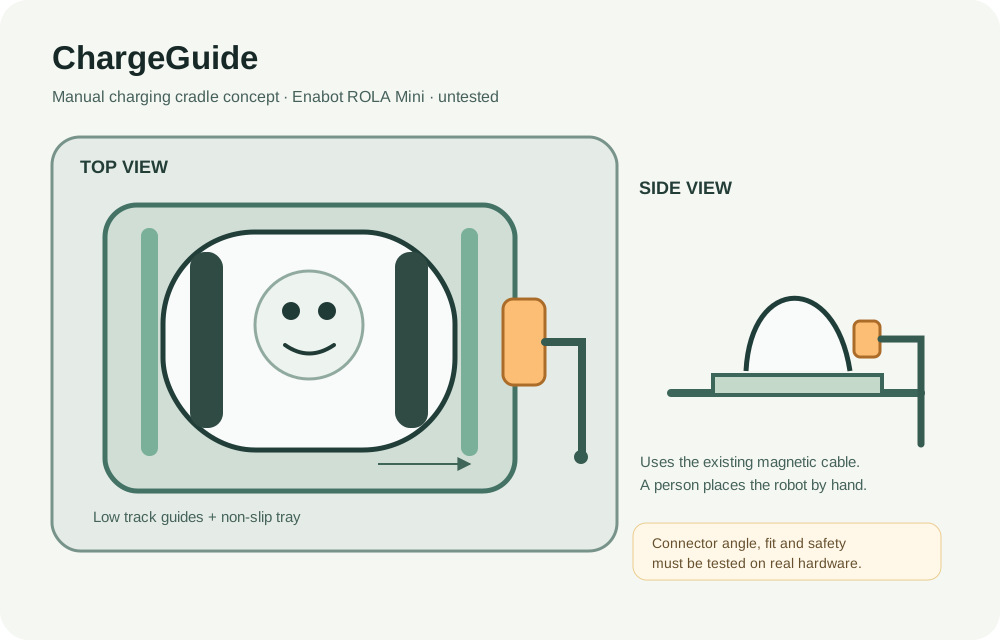
- The proposed tray sits on a level floor with non-slip feet. Low guides locate the ROLA Mini's tracks; a soft rear stop limits travel. Dimensions shown in the diagram are illustrative, not measured specifications.
- A removable, slightly adjustable carrier holds the existing magnetic head at the port's measured height and angle. A rear channel routes cable slack away from tracks and curious pets.
- A person places or rolls the robot into position, confirms the charging light, and lifts it out when charged. No new battery, electronics, automatic navigation or charging circuit is proposed.
Directions worth considering
Wall clip and floor marker
Benefit: The lowest-cost way to retain cable position.
Tradeoff: Wall and floor geometry varies, and the robot still needs careful alignment.
ChargeGuide shallow cradle
Benefit: Track guides, a soft stop and a cable carrier could make placement more repeatable without new electronics.
Tradeoff: Model-specific fit, pet exposure, cable strain and meaningful advantage over USB-C all need testing.
USB-C parking stand
Benefit: Bypasses magnetic alignment using Enabot's supported direct-charge method.
Tradeoff: The owner still plugs the cable in each time; a stand may add little value.
Our recommendation: Prototype the shallow cradle and test it against both a taped cable and direct USB-C. Continue only if real owners can place the robot more reliably and consider that improvement worth paying for. Do not call it a self-charging dock.
Build the first version
Print an adjustable cable holder and two short track guides on a non-slip base. Use the genuine cable. Leave out electronics, decorative housing and automatic docking; first prove that the connector seats without strain.
Materials and production options
- First prototypes: 3D-printed PETG guide parts or laser-cut HDPE base, replaceable silicone pads, and non-slip feet. These are design candidates, not tested materials.
- Possible production: injection-molded ABS/PC or thermoformed HDPE tray with soft TPE stops and a clip-in cable carrier. Obtain actual material, flammability and cost advice before manufacturing.
Prototype checks
- Measure real ROLA Mini units and genuine cables, including port position, adapter angle, track width and status-light visibility; avoid assuming the public 116 × 116 × 110 mm overall size defines the charging interface.
- Build an adjustable, non-electrical tray and compare at least 30 manual charging placements with a taped cable and direct USB-C. Record start and continuity of charging and cable strain.
- Test on several hard floors and with gentle cable pulls, then review pet chewing, hair accumulation, cleaning, heat and warranty questions. Keep animals away from early prototypes.
05 / Business assumptions
Could this support a business?
A model-specific accessory is the initial business hypothesis. Charging frequency, the number of affected owners and the reachable customer base are unknown. Supplier quotes and actual customer acquisition costs are needed before judging margins or a standalone business.
Price to test
$29 USD is a question for owners, not a validated selling price. The robot itself was listed at $169 and its replacement magnetic cable at $9.99 when checked, making price sensitivity important.
Costs still to verify
At a hypothetical $29 direct-sale price, an $8 packed-product ceiling is an internal planning target, not a supplier quote. It excludes freight, tax, returns, fees and marketing.
Where the first customers might come from
Start with existing ROLA Mini owners who report charging friction. A practical charging guide linked from the robot profile could reach them; owner communities and specialist pet-camera retailers are possible places for later feedback or demonstrations, subject to their rules. No traffic or distribution agreement is established.
Why this belongs on HomeRobotHQ
This idea extends the ROLA Mini profile with a practical comparison of magnetic charging, direct USB-C and a proposed accessory. Owners can use the existing charging alternatives today; makers can investigate the remaining positioning problem. See the Enabot ROLA Mini profile for robot context.
06 / Next experiment
What should a builder test first?
The first decisive test: On real hardware, compare the cradle with direct USB-C and a retained magnetic cable. Measure successful charging starts, placement time and connector strain before asking owners whether the improvement is worth $29.
Next validation steps
- Interview 10–15 actual ROLA Mini owners about charging frequency, current setup and failures before showing the proposed solution.
- Compare the physical prototype with a taped cable and USB-C, then show the concept and $29 price question to owners who report friction.
- Treat any waitlist submission as stated interest only. Recheck official accessories and third-party alternatives before tooling or a public sale claim.
What would make us drop this idea?
- Repeated placements with a cheap wall clip or direct USB-C match or outperform the cradle.
- The guide cannot retain charge reliably without loading the connector or trapping the robot.
- Qualified ROLA Mini owners understand the manual-use limit and still consistently reject the concept at $29.
- A current ROLA Mini-compatible accessory already provides the same benefit at lower total cost.
Practical risks to check before going further
- The robot's claimed long battery life means many owners may charge too rarely to want a cradle.
- Direct USB-C or a taped cable may perform just as well at near-zero cost.
- Magnetic contact may remain unreliable even in a guide; side pressure could damage the adapter or port.
- Pets may tug or chew a visible cable, and the tray may collect hair or slip.
- Official store inventory currently differs by region, and a model revision could change the charging interface.
- A passive cradle does not satisfy requests for the robot to navigate and recharge itself.
Explore building this idea
Start with the prototype plan and compare it with the existing alternatives. The consumer page shows how the proposed benefit and price could be presented to owners.
Go to the prototype plan ↑View ChargeGuide for owners ↗07 / Sources and updates
How we reached this starting point.
Research method
Research using manufacturer documentation, accessory listings and selected public owner reviews. No hands-on hardware test or owner interview has been completed. Syndicated review copies are treated as one observation, and uncertain post dates remain explicitly uncertain.
Post dates below refer to the underlying evidence; checked dates show when the source was reviewed. A recent check does not make an old post recent. Individual reports do not establish market size.
Source notes
- ROLA Mini manual charging instructions ↗Enabot manual hosted by B&H · Checked
The manual instructs users to attach the magnetic head and fix both cable and robot on the ground or wall while charging. Manual originated around 2024; current Enabot support was checked separately to confirm manual charging remains the product design.
- Current ROLA Mini support FAQ ↗Enabot · Checked
Confirms no auto-charge and permits direct USB-C charging after removing the magnetic adapter. Manufacturer guidance does not demonstrate owner demand for a cradle.
- One owner-built charging platform ↗Desertcart syndicated product reviews · Checked
One review describes trouble positioning the magnetic connection and a homemade platform used to line up the robot. Country mirrors display inconsistent review dates, from December 2025 to August 2026. Original publication date and verified purchase could not be confirmed; count once, without a firm post date.
- Separate owner complaint about manual charging ↗Desertcart syndicated product reviews · Post · Checked
A French-language review says manual charging is inconvenient for this robot. The owner wants automatic charging; a passive cradle would address only the placement step. Date is storefront-displayed and original review source is unverified.
- Current official accessory catalog ↗Enabot · Checked
Lists ROLA Mini magnetic cable at $9.99 and charging docks for several other models, but no ROLA Mini cradle in this catalog. This does not rule out every third-party accessory; listed prices may change.
- ROLA Mini retailer inventory ↗B&H Photo · Checked
Retailer showed the robot in stock at $169 and the magnetic USB-C cable in the box. Stock changes, and some retailer feature text conflicts with Enabot's official no-auto-charge documentation.
- ROLA Mini official storefront ↗Enabot · Checked
Official regional listing displayed $169, 77 reviews and out-of-stock status. Review count is not a sales estimate or a measure of charging difficulty; availability varies by region.
Report updates
- : Added a builder overview, commercial assumptions and a clearer first test. This format revision adds no new owner evidence or hardware results.