Research verdict
A major humanoid program worth tracking, but not a robot a household can buy today.
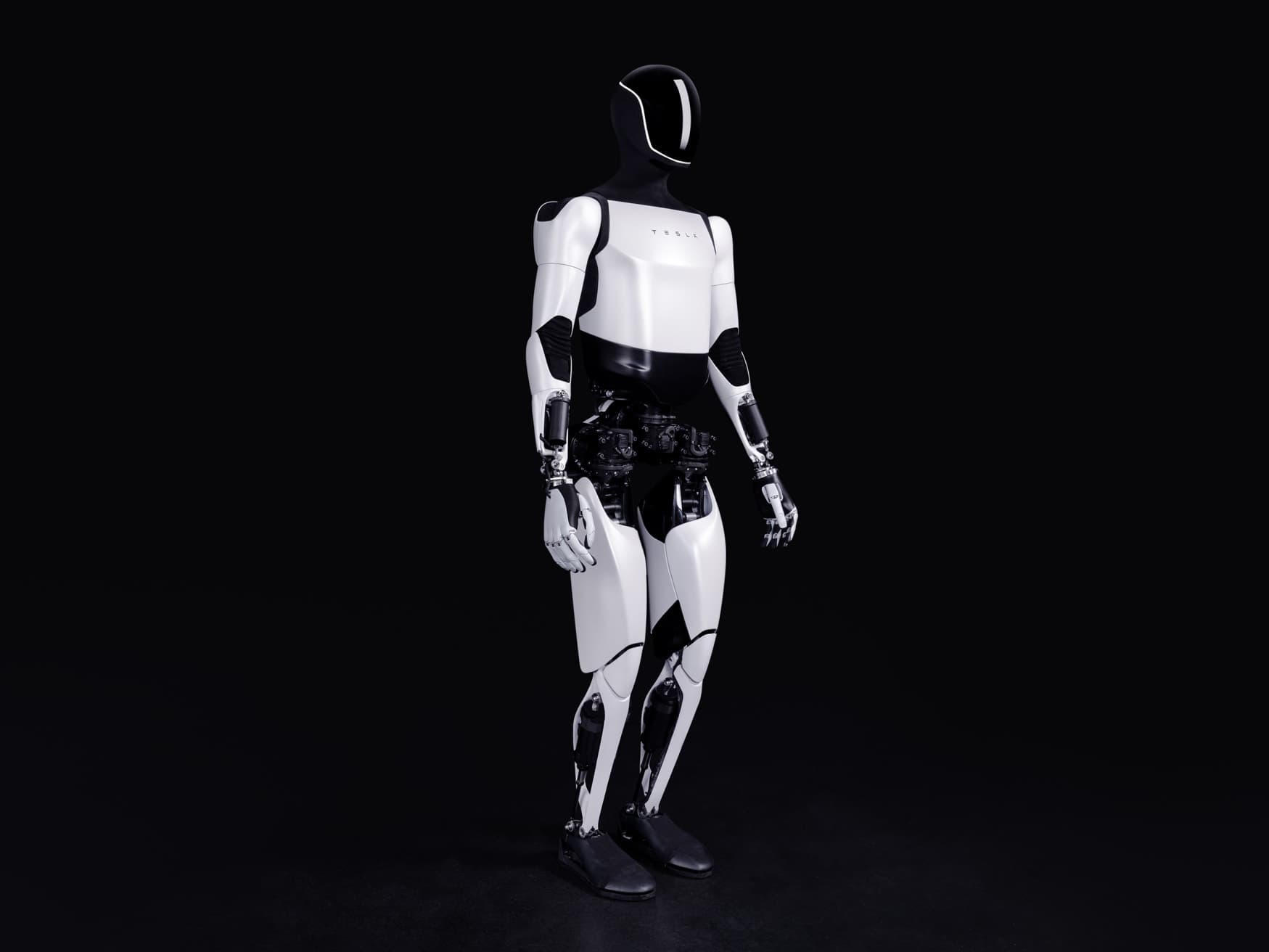
Optimus is a significant humanoid program because Tesla is building dedicated production capacity and training infrastructure around it. That does not yet make it a consumer product. Tesla's latest investor update says the first builds are intended for its Optimus Academy to collect training data and develop functionality. No public retail price, consumer order page, shipping schedule, or finalized production specification is available.
Optimus belongs in a serious home-robot database because Tesla explicitly describes a general-purpose autonomous humanoid and is installing production lines. It should not be placed beside NEO, G1, or R1 as if all four are equivalent purchase options. For now, Optimus is best treated as an announced development program. Tesla's factory-capacity targets are useful indicators of ambition, not evidence of delivered volume, consumer availability, or proven household autonomy.
Best fit
- Readers tracking the development of high-volume general-purpose humanoids
- Teams comparing announced autonomy programs with robots that can already be ordered
- Researchers following how Tesla connects AI training, manufacturing, and humanoid hardware
Probably not for
- Households that need a robot they can order or reserve today
- Buyers comparing verified prices, delivery dates, warranties, and support terms
- Developers who need a documented public SDK or a purchasable research platform
Price and key facts
A normalized snapshot with evidence attached.
These fields use the same structure across every HomeRobotHQ profile. Each value is linked to its evidence, classified transparently, or marked as not published.
- Listed price
- Price not announced; no consumer order page Not published · Checked
- Availability
- In development; not currently offered for consumer sale HomeRobotHQ classification · Checked Open evidence ↗
- Mobility
- Bipedal mobility is part of the documented program goal Official source · Checked Open evidence ↗
- Connectivity
- Current production connectivity not published Not published · Checked
- Cloud dependence
- Consumer software and cloud requirements not published Not published · Checked
- Camera
- Current production camera configuration not published Not published · Checked
- Microphone
- Current production microphone configuration not published Not published · Checked
- Developer access
- No public Optimus developer SDK documented HomeRobotHQ classification · Checked Open evidence ↗
- Charging
- Charging method not published for the current production design Not published · Checked
- Documented runtime
- Runtime not published for the current production design Not published · Checked
- Dimensions
- Dimensions not published for the current production design Not published · Checked
- Weight
- Weight not published for the current production design Not published · Checked
- Subscription
- Consumer pricing and service model not announced Not published · Checked
Additional documented facts
Price, delivery timing, taxes, shipping, and regional availability can change. Verify the current official listing or status source before making a purchase decision. View the reviewed price history →
Capabilities and limits
What has Tesla actually documented about Optimus?
Tesla describes the goal as a general-purpose, autonomous, bipedal humanoid that can perform unsafe, repetitive, or boring tasks. Current public materials document the program and production preparation, not a consumer-ready feature list.
Structured capability evidence
“Supported” means the maker documents the capability. Each entry identifies its source, configuration limits, and evidence type.
Biped mobility
SupportedTesla defines Optimus as a bipedal humanoid program.
Autonomous navigation
LimitedAutonomous navigation is part of Tesla's stated end goal, but no consumer-ready navigation specification is published.
Self-charging
Not documentedTesla has not published a charging workflow for a commercial Optimus configuration.
Object carrying
Not documentedNo payload figure is published for the current production design.
Object manipulation
LimitedPhysical-world interaction is part of the program goal, but the reviewed sources do not define a repeatable commercial manipulation package.
Household tasks
Not documentedTesla has not published a supported household task catalog or consumer service.
Remote operation
Not documentedNo customer-facing remote-control or human-assistance workflow is documented.
Developer control
Not documentedTesla has not published an Optimus SDK or external developer package; initial builds are assigned to internal training and development.
Evidence snapshot checked . “Not documented” means we did not find a reliable claim in the reviewed sources; it is not proof that the capability is impossible.
- 01Use a bipedal humanoid body plan intended to work in environments and around tasks designed for people
- 02Apply Tesla's vision and planning approach to balance, navigation, perception, and physical-world interaction
- 03Support the long-term goal of performing unsafe, repetitive, or boring work
- 04Generate training data and develop additional functionality through Tesla's initial Optimus Academy builds
Important limitations
- Optimus is not currently offered through a public consumer order or preorder page, and Tesla has not published retail pricing or delivery terms.
- Tesla's stated factory capacities describe line design targets. They are not forecasts of units produced, sold, or delivered in a particular year.
- The latest investor update assigns initial builds to training-data collection and functionality development, not household deliveries.
- Current public materials do not provide a complete production specification for runtime, payload, sensors, charging, dimensions, weight, or household task reliability.
Software and setup
Vision, planning, and training are central to the program, but Tesla has not published a consumer software package.
Tesla says its robotics approach depends on advanced AI for vision and planning, together with software for balance, navigation, perception, and interaction with the physical world.
The company has not published a consumer app, supported household task catalog, public Optimus SDK, or update policy for prospective owners.
A staged demonstration should not be treated as proof that the same task is autonomous, repeatable, safe, or included in a future retail product.
Do not plan a household deployment until Tesla publishes an order path, supported use cases, safety documentation, and delivery terms.
When a commercial configuration appears, recheck price, dimensions, payload, runtime, charging, connectivity, warranty, support, and regional availability.
Require explicit documentation for autonomous versus supervised behavior and for any remote human involvement.
Review camera, microphone, data retention, remote access, and account controls before considering use inside a home.
Projects worth exploring
- Maintain a dated timeline of official Optimus production and availability statements
- Separate demonstrated behaviors from documented repeatable product capabilities
- Compare future retail specifications with 1X NEO and current Unitree platforms
- Track whether Tesla publishes a developer path, consumer service model, or household privacy controls
Privacy and connectivity
A consumer privacy model cannot be evaluated until Tesla publishes the sensing, connectivity, account, and data-handling details.
Tesla has not published a consumer Optimus privacy specification covering sensors, recordings, remote access, data retention, or household controls.
The official AI page refers broadly to vision, planning, perception, and physical-world interaction. Those goals are not enough to infer what data a future consumer robot would collect or where processing would occur.
Treat future privacy and connectivity claims as unverified until they appear in product-specific documentation and customer terms.
Alternatives
Compare the role before the specification.
Sources and provenance
Primary sources reviewed.
Follow the sources for the specifications, software requirements, and policies discussed above. Our editorial approach explains how evidence is used.
- Official product pageAI & Robotics: Tesla OptimusOpen source ↗
Tesla · Checked 2026-09-18
- Official investor updateQ4 2025 updateOpen source ↗
Tesla Investor Relations · Checked 2026-09-18
- Official investor updateQ1 2026 updateOpen source ↗
Tesla Investor Relations · Checked 2026-09-18
- Official investor updateQ2 2026 updateOpen source ↗
Tesla Investor Relations · Checked 2026-09-18