01 / The opportunity
Why might someone buy this?
A fitted, diffused and electrically engineered unit might be simpler and more repeatable than switching on a whole room or assembling an LED circuit. It needs to beat a cheap generic lamp in a paired test; otherwise there is little reason to pay for it.
Who might need it?
- Loona owners with the original charging dock in a dim but otherwise suitable spot, especially when the robot reaches the dock zone yet struggles at the station.
- Owners whose robot never reaches the dock, has wheel-contact faults, sits on long-pile carpet or lacks an appropriate route should use the official setup and support path first; a marker light is unlikely to be their primary fix.
Loona's return-to-charge experience has two stages: reaching the dock area and recognizing, aligning with, and contacting the station. KEYi's current instructions address room layout, route creation, brightness, background color, floor and wheel conditions. A light would only address part of the second stage.
Recent independent owner posts still ask about failed automatic returns, but they do not say a dark marker caused the failure. The narrower product hypothesis comes from current official environmental guidance and one older owner-built light, not a demonstrated 2026 cluster of light-specific complaints.
02 / Existing solutions
How owners handle it today.
| Current solution | What it does | What remains |
|---|---|---|
| Official route and dock setup ↗ | Auto Recharge 2.0 routes guide Loona toward the dock, while KEYi recommends space, light, contrast and a flat nonslip surface. | Free and essential, but it can still leave a dim yet otherwise convenient dock spot. A lighting accessory must be tested only after this setup. |
| Room light, new location or generic lamp ↗ | More light or a better background may improve station visibility without a specialized product. | A whole room light may be inconvenient; a loose lamp can occupy space and need careful positioning. Neither limitation proves a paid clip is worth it. |
| One maker-built marker light ↗ | A published 2025 file puts an LED on the original dock mast to illuminate its visual target locally. | It requires printing, wiring and safe current control; the maker warns against directly powering the chosen 3.3 V LED from 5 V USB. No controlled effect or current-revision fit was verified. |
What a better product would need to do
- Preserve the official dock, marker visibility, charging contacts, side clearance and rearward approach path; do not interfere with Auto Recharge 2.0 routes.
- Deliver even adjustable light without direct camera glare or hot spots; confirm the beam helps rather than confuses recognition.
- Enclose and current-limit a low-power LED properly, manage heat and route the cable behind the dock away from Loona, children and pets.
- Measure actual original-dock mast revisions and compare successful contact rates against normal room lighting and a generic lamp before claiming value.
03 / Research evidence
How strong is the evidence?
Opportunity type: Current setup constraint with one historical DIY adaptation
The manufacturer calls out brightness, contrast, stable flooring and route setup in current instructions. One April 2025 DIY file shows a light mounted at the dock marker. July and August 2026 owner discussions show broader return-to-charge friction, but neither diagnoses poor marker visibility. Interest, prevalence and willingness to pay are unknown.
HomeRobotHQ lists Loona as available and describes charging dock availability by bundle. KEYi's April 2026 Auto Recharge 2.0 tutorial addresses routes and changing light. Its current Japanese FAQ recommends brightness, background contrast, a level nonslip floor and clear dock space. KEYi listed the dock at $79 USD on the checked page. A maker posted a clip-on marker light file in April 2025.
Some owners with a genuinely dim dock area may benefit from localized illumination after correct route and physical setup. The observed DIY attempt makes a ready-to-use, correctly powered clip plausible, but no result in the checked sources establishes that it raises docking success.
How many present-day failures are due to near-dock visibility rather than route, floor, wheel, firmware or hardware; whether localized lighting actually helps; useful brightness and color; current dock mast variants; assembled cost, compliance and willingness to pay.
Selected evidence
Current Japanese Loona charging FAQ ↗
Live guidance asks for brightness, surrounding space, background contrast and a level nonslip floor; it also distinguishes wheel and alignment checks. English summaries here paraphrase Japanese text.
Checked: No dated revision or controlled light test is supplied. Regional guidance may differ from other markets.Maker-built Loona charging-station light ↗
One maker posted a clip-mounted LED design for the dock mast and describes current limiting, wiring and heat concerns.
Post: · Checked: Historical DIY example, not a controlled performance report, current owner prevalence or verified current-dock fit.KEYi Auto Recharge 2.0 setup tutorial ↗
The manufacturer says room complexity and light changes can affect finding the dock and instructs owners to create and update routes.
Post: · Checked: A route guide does not validate a marker-light accessory or distinguish route failures from near-dock visibility failures.July 2026 Loona support discussion ↗
A July 21 owner reply says automatic charging return fails. The reply showed two votes and the opening thread nine votes in retrieved search output.
Post: · Checked: No cause was diagnosed. Reply and thread votes are not prevalence or willingness-to-pay measures.The current KEYi FAQ still treats brightness and contrast as docking conditions; one April 2025 maker built a marker light. July and August 2026 owner discussions show wider dock-return friction but no lighting-specific diagnosis. The July support thread opener showed nine votes in search results; thread engagement is not prevalence or purchase intent. Loona and its dock are currently listed, but installed base and willingness to pay remain unknown.
Search interestFocused web search on 2026-10-05 found current official setup material, a maker file and public owner discussion. No reproducible Google Trends series or sourced search-volume number was available for a Loona dock light. Search phrases are editorial hypotheses, not traffic estimates. No assembled model-specific light was found in the focused search, which does not prove none exists.
04 / Product design
How the product could work.
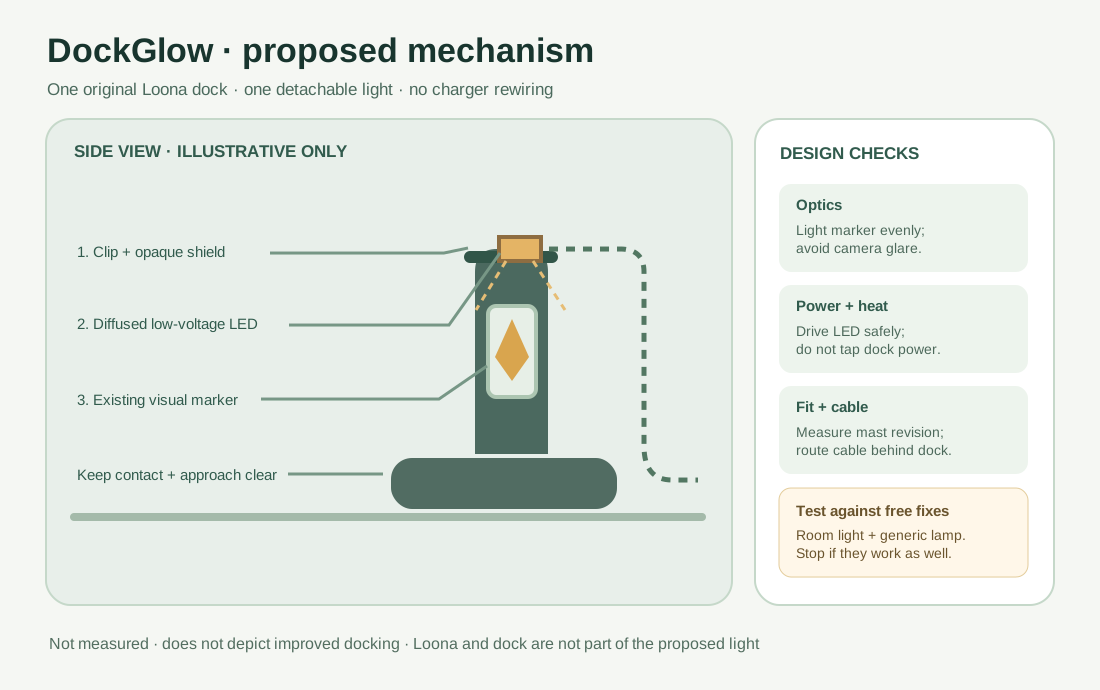
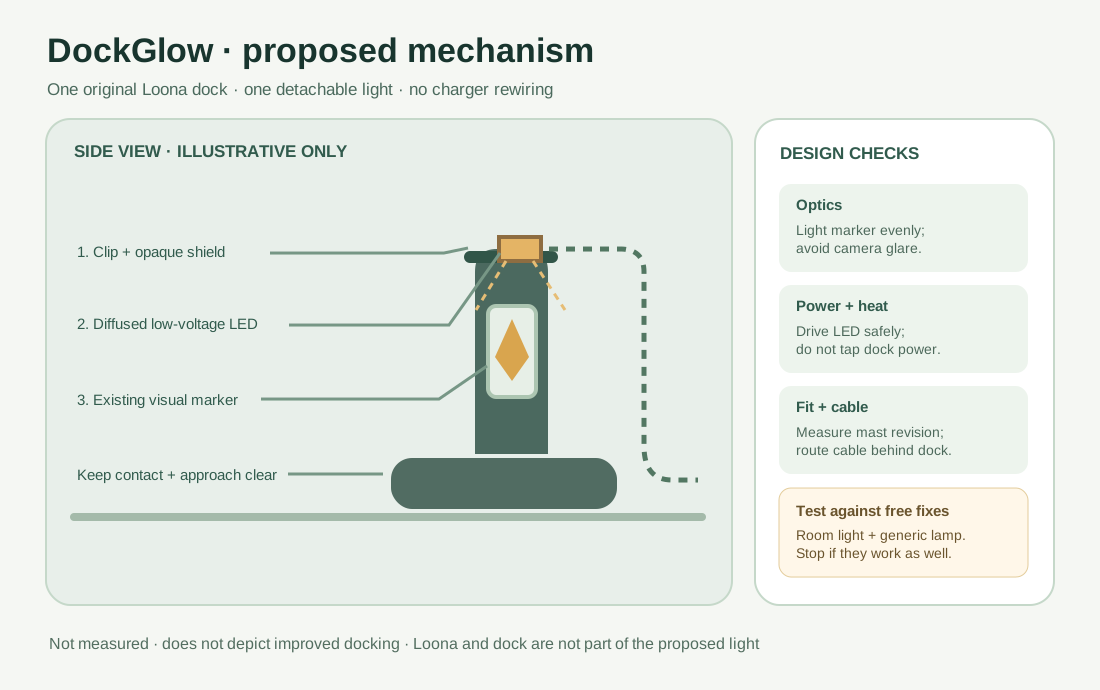
- First, configure KEYi Auto Recharge 2.0 routes and check the official placement conditions. DockGlow would not replace either step. Its first use case begins only when Loona already reaches the station area but dim light may limit visual recognition.
- A measured clip would attach to one compatible original dock mast. A shaded, diffused low-voltage LED would aim at the existing marker without covering it or shining directly toward Loona's camera. A cable would exit behind the station to an independent power source, never through the dock's charger circuitry.
- The builder would tune the beam using real Loona docking trials, checking for glare, heat, cable clearance and charge-contact success. Brightness, color, geometry and operating instructions cannot be fixed from desk research alone.
Directions worth considering
Passive contrast card
Benefit: May separate a dark dock from a similar-colored background without power or electronics.
Tradeoff: A sheet of contrasting material is nearly free, so a paid version needs an unproven convenience advantage and cannot solve low illumination alone.
DockGlow diffused marker light
Benefit: Local light and a purpose-fit clip could replace whole-room lighting and avoid a maker electronics project for a narrow owner setup.
Tradeoff: Requires exact fit, thermal and electrical design, glare testing and a clear advantage over generic USB lamps.
Full dock-zone mat with light and backdrop
Benefit: Could combine stable floor, contrast and light in one planned station zone.
Tradeoff: More material, shipping volume and compatibility work before anyone knows whether local light alone matters.
Our recommendation: Test the simple removable marker light first, not a replacement dock. Enroll only near-dock visibility cases, compare with normal lighting and a generic lamp, and stop if those free or cheap options are equally effective. Do not describe broad failed auto-return reports as proof that this light will help.
Build the first version
A detachable clip, shaded diffused low-voltage light and rearward cable route for one measured revision of the original Loona dock. Use a properly current-controlled off-the-shelf LED module; do not alter the dock's electronics or obscure its marker, contacts or approach lane.
Materials and production options
- Prototype: measured PA12 or PETG clip, opaque light shield, frosted polymer diffuser, insulated cable and a properly current-controlled off-the-shelf low-power 5 V LED module. Use an independent power supply rather than modifying the original dock.
- Potential production: molded polymer clip and light enclosure with an engineered LED board, strain relief and compliant power design after optical, thermal, mechanical and electrical tests. No supplier or certification quote has been obtained.
Prototype checks
- Measure several current and older original Loona docks for mast shape, marker location, rear exit clearance and charging-contact path. Verify that a clip cannot hide the marker or get caught by the robot.
- Build a printed shield and diffuser around a properly driven low-power LED. Adjust beam direction and measure surface temperature, cable clearance and marker illumination across dark and normally lit rooms.
- Observe repeated supervised return attempts on the same routes under dim baseline, room light, generic USB lamp and DockGlow prototype conditions. Record reaching the dock, marker recognition, alignment, successful charge contact and new failures separately.
05 / Business assumptions
Could this support a business?
A tiny fitted accessory could appeal to a narrow group whose dock location is dim. The business may fail if free changes or a cheap lamp work just as well, the installed dock base is too small, or electrical, shipping and support costs overwhelm a low target price. No margin is known.
Price to test
$24 USD is an unvalidated target-price question for an assembled, compatible light. Compare it with free room lighting, a contrasting background and generic USB lamps before asking owners to pay for a fitted unit. KEYi's current $79 dock listing is a distinct product, not a pricing benchmark for a light.
Costs still to verify
No bill of materials, supplier quote, tooling estimate, electrical-compliance plan, packaging, fulfillment, return, support or acquisition cost exists. A safe LED circuit and secure cable route may cost more than expected. No margin can be calculated yet.
Where the first customers might come from
Owners already reading Loona charging-dock troubleshooting content on HomeRobotHQ may be reachable through the Loona profile and a targeted guide. Queries around dock lighting and failed returns are editorial hypotheses, not measured traffic. Interview affected owners before promotion.
06 / Next experiment
What should a builder test first?
The first decisive test: Observe current Loona owners with near-dock failures after official setup. In the same room and route, compare repeated docking attempts in dim baseline light, normal room light, generic USB lamp light and prototype light; separate reaching the station from recognizing and making charging contact.
Next validation steps
- Interview Loona owners with current near-dock failures after official route setup. Ask for dock revision, firmware, floor, background, light conditions, attempted remedies and where in the return sequence failure occurs. Do not infer a light problem from a general charging complaint.
- In consenting homes, compare repeated supervised trials under dim baseline, room light, generic lamp and prototype light, holding route and dock location constant. Separate arrival, recognition, alignment and charging contact outcomes.
- If the physical mechanism helps, show an actual prototype and the $24 target price to affected owners. Compare their preference with a generic lamp; a waitlist signup alone is not proof of a sale.
What would make us drop this idea?
- Observed present-day near-dock failures do not improve when marker illumination changes, or the real failure is route, floor, wheel or hardware related.
- A basic room light or generic USB lamp performs just as well without a meaningful convenience loss.
- Glare, temperature, cable management or dock fit cannot be made acceptably safe and reliable across the intended revision.
- Affected owners do not value a $24 purpose-fit light after seeing and testing cheaper alternatives.
Practical risks to check before going further
- The visible failure may actually begin before Loona reaches the dock; light cannot replace route planning or correct firmware, wheel, carpet, alignment or defective-hardware issues.
- A poorly aimed light may overexpose the marker or confuse vision. A hot LED, unstable clip or exposed cable could create electrical, trip or robot-interference hazards.
- Dock mast revisions may defeat a universal clip; published overall robot dimensions do not establish accessory fit.
- Free setup changes and low-cost generic lamps may make a specialized accessory unnecessary for most owners.
- A $24 target leaves uncertain room for safe manufacturing, testing, shipping, support, returns and acquisition. Manufacturer marks and compatibility claims require careful review.
Explore building this idea
Start with the prototype plan and compare it with the existing alternatives. The consumer page shows how the proposed benefit and price could be presented to owners.
Go to the prototype plan ↑View DockGlow for owners ↗07 / Sources and updates
How we reached this starting point.
Research method
Focused desk research of the indexed Loona profile, KEYi's 2026 route tutorial, current Japanese support FAQ, current dock listing, an April 2025 owner-made LED mount and two 2026 public owner discussions. The Japanese FAQ was paraphrased in English. No Loona or dock was measured, no prototype was built, no illumination or docking trial was run, and no owner was interviewed. Public posts were summarized without copying comments, usernames or images.
Post dates below refer to the underlying evidence; checked dates show when the source was reviewed. A recent check does not make an old post recent. Individual reports do not establish market size.
Source notes
- HomeRobotHQ Loona profile ↗HomeRobotHQ · Checked
The indexed profile describes Loona as an available wheeled companion and notes that charging accessories vary by bundle. Its source set was checked September 1, 2026. Editorial robot context, not evidence of lighting-specific owner need or accessory demand.
- KEYi Auto Recharge 2.0 setup tutorial ↗KEYi Tech · Post · Checked
The manufacturer says room complexity and light changes can affect finding the dock and instructs owners to create and update routes. A route guide does not validate a marker-light accessory or distinguish route failures from near-dock visibility failures.
- Current Japanese Loona charging FAQ ↗KEYi official Japan site · Checked
Live guidance asks for brightness, surrounding space, background contrast and a level nonslip floor; it also distinguishes wheel and alignment checks. English summaries here paraphrase Japanese text. No dated revision or controlled light test is supplied. Regional guidance may differ from other markets.
- Current official Loona dock listing ↗KEYi Tech · Checked
The original charging dock was displayed at $79 USD and remains a current accessory. Price and stock can change. Dock availability is not demand for a separate light, and the listing does not prove a light is absent from all channels.
- Maker-built Loona charging-station light ↗Public maker-file page · Post · Checked
One maker posted a clip-mounted LED design for the dock mast and describes current limiting, wiring and heat concerns. Historical DIY example, not a controlled performance report, current owner prevalence or verified current-dock fit.
- July 2026 Loona support discussion ↗Public Loona owner discussion · Post · Checked
A July 21 owner reply says automatic charging return fails. The reply showed two votes and the opening thread nine votes in retrieved search output. No cause was diagnosed. Reply and thread votes are not prevalence or willingness-to-pay measures.
- August 2026 app-update discussion ↗Public Loona owner discussion · Post · Checked
An August 28 owner reply asks about mapping a return to the charging station after an app update. That reply showed two votes in retrieved search output. This is a route/navigation concern, not evidence that local dock illumination would solve the issue; reply engagement is not demand.
Report updates
- : Initial unpublished research. Scoped the concept to near-dock visibility, compared current official setup with an older DIY light and recent nonspecific docking complaints, and defined a test against free and generic alternatives.