01 / The opportunity
Why might someone buy this?
An affected owner might pay for quieter hard-floor play that does not make Loona harder to turn. A price premium is justified only if a measured comparison beats an existing soft cover without new fit or maintenance problems.
Who might need it?
- Owners using Loona on smooth indoor wood, laminate or tile who find front-wheel knocks intrusive.
- Owners whose current flexible covers noticeably hinder turning; confirm that removal restores normal movement before attributing the fault to cover grip.
- Not a traction upgrade, outdoor tire, high-pile carpet solution or repair for a malfunctioning motor.
The relevant sound is front-wheel contact with a hard floor. Grinding, damaged gears, speech volume and general navigation faults are different problems that need diagnosis.
No DIY with a cushioned inner layer and a separate smooth outer band was found in this focused research. The proposed hybrid mechanism is original to this concept.
02 / Existing solutions
How owners handle it today.
| Current solution | What it does | What remains |
|---|---|---|
| Use the original front wheels ↗ | Keeps the factory geometry and sliding surface. Removing an aftermarket cover provides a useful turning baseline. | It does not add impact cushioning; a July 2026 owner comment describes bothersome stomping on a wood floor. |
| Loonelli Wide flexible front covers ↗ | A dedicated pair offers soft floor contact. The seller lists TPU options and a displayed $17.92 USD price. | A September buyer reports difficulty turning. The seller warns about extra grip; the claimed noise reduction is not an independent QuietGlide benchmark. |
| Choose a firmer cover material ↗ | The same maker offers different hardness options and describes retention and movement tradeoffs. | A firmer simple cover may already be good enough. QuietGlide must outperform an appropriate existing variant, not just the softest unfavorable comparison. |
What a better product would need to do
- Reduce contact noise without worsening turns compared with bare wheels and a suitable existing cover.
- Separate radial compliance from the smooth floor-contact surface; do not improve grip on these passive front wheels.
- Capture both band halves mechanically, without exposed fasteners, a sharp seam or pieces that can detach during play.
- Keep diameter increase, mass, axle clearance, body clearance and dock approach within a range tested on the actual revision.
- Avoid floor marking, trapped grit, rattling and wear; check finished wood and tile separately.
03 / Research evidence
How strong is the evidence?
Opportunity type: Improvement to an existing niche accessory, prompted by a recent owner problem.
A September 5, 2026 buyer review reports turning difficulty with Loonelli Wide covers. The seller also warns about grip hindering turns. A July owner comment asks for less stomping. These are useful task signals, not a prevalence estimate or evidence that QuietGlide works.
A current Loona-specific front-cover listing exists. Its September buyer feedback mentions difficult turns, and its seller warns that front-wheel grip can hinder turning. Regional support describes the front wheels as passive.
Keeping a compliant layer inside and a smoother contact band outside may separate impact cushioning from lateral friction. That is an engineering hypothesis, not an observed owner modification.
Whether a compact cover can absorb enough impact without catching, rattling or loosening; how floors and wheel revisions change the result; whether the improvement would justify its price.
Selected evidence
Loonelli Wide: current cover and September turning feedback ↗
A recent buyer reports difficult turns; the maker warns that increased grip can hinder movement. Displayed reference price is $17.92 USD with 51 item reviews.
Post: · Checked: Isolated buyer feedback; exact floor and robot revision unspecified. Retrieved prices and counts may be cached or localized. Seller performance claims have not been independently measured.July 2026 request for less stomping ↗
A relevant comment describes wood-floor stomping and requests less of it.
Post: · Checked: A single relevant comment in a broader July 15 thread. Its visible +1 score is not traffic, prevalence or buying intent; firmware and measured sound are absent. Community-size comparison was not available.Regional Loona support: passive front wheels ↗
The Turkish support page explains that the front wheels are passive and may not roll on some smooth surfaces.
Checked: Undated regional guidance, not a dimensioned drawing or independent friction measurement. Confirm architecture on the actual target revision.The retrieved Wide listing displays 51 item reviews and a $17.92 USD price, showing an existing accessory category rather than sales volume. Its September turning report is a narrow problem signal. Shop totals, review counts and a comment score cannot estimate QuietGlide demand.
Search interestNo dependable keyword volume, Search Console export or reproducible Trends series was available. Loona wheel noise and Loona wheel covers are discovery phrases, not proven high-volume terms. A later guide should answer the actual turning tradeoff before linking to the concept.
04 / Product design
How the product could work.
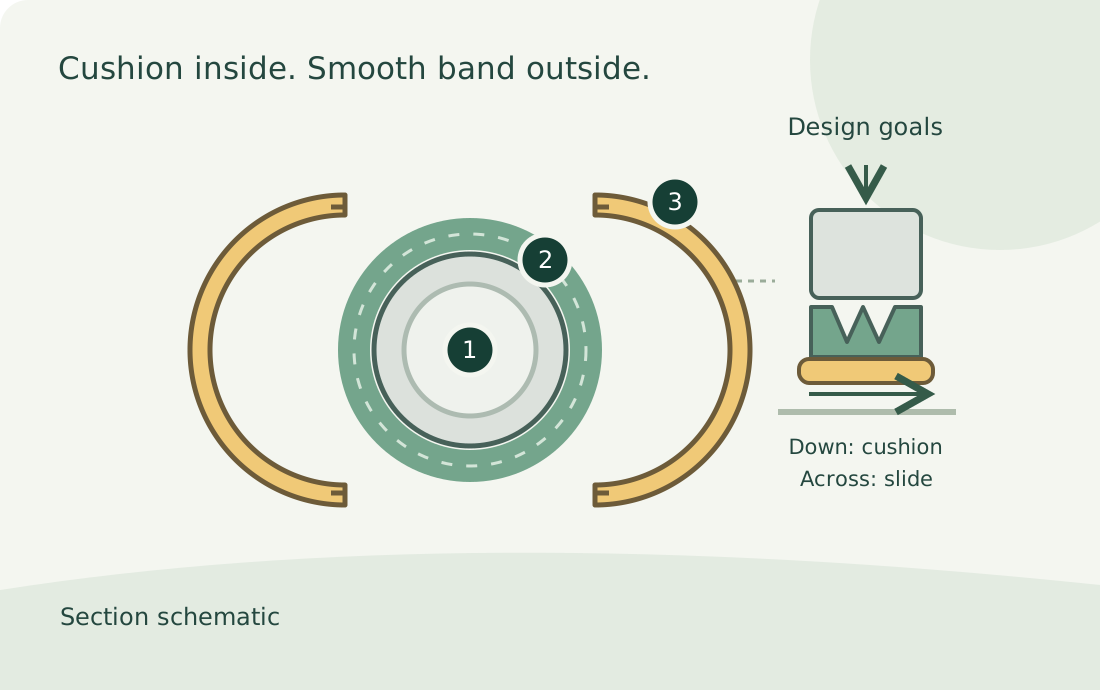
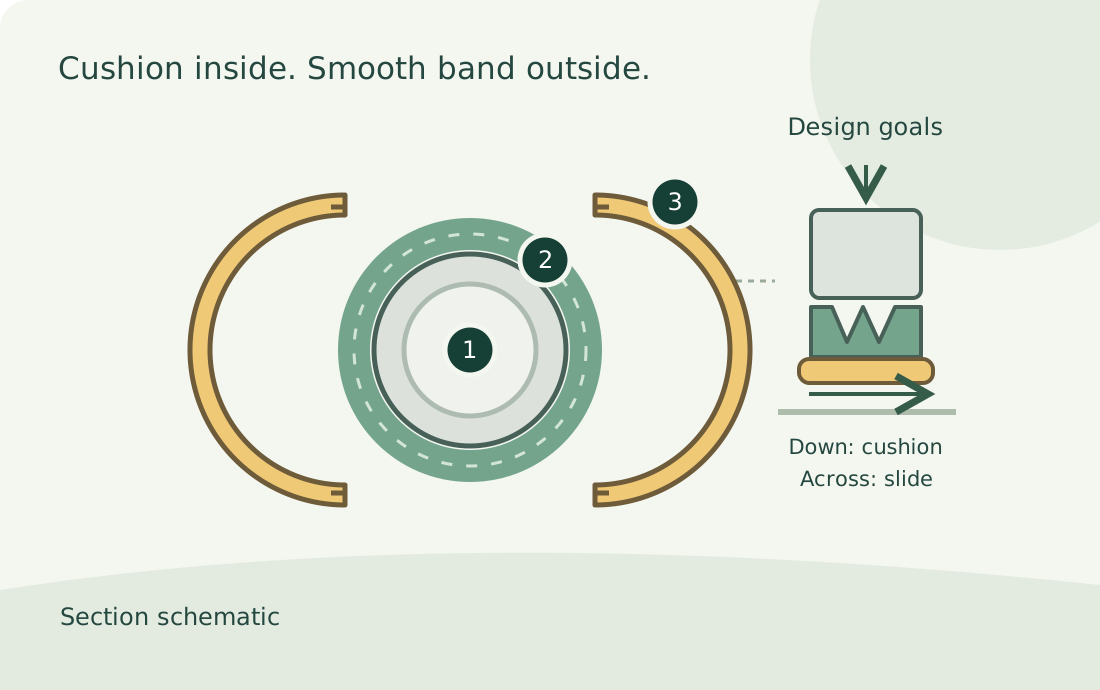
- 1 / Existing passive wheelThe factory front wheel stays. Axle and body clearances must be measured.
- 2 / Soft inner cushionA compliant sleeve is intended to absorb radial contact, away from the floor surface.
- 3 / Smooth outer bandCaptured band halves provide the sliding surface. Retention and seams need tests.
- A compliant sleeve seats around the measured circumference of each passive front wheel. Its profile must avoid rubbing the axle or nearby body.
- Two smooth band halves surround the sleeve. Captured keys and recessed joints are a proposed closure, not a verified snap fit; reject the design if they can release during use.
- Radial wheel contact loads the cushion beneath the band. The intended energy absorption depends on actual deflection, stiffness and impact speed.
- During a turn, the smoother outer surface is intended to slide sideways. Its floor friction and seam behavior must be measured rather than inferred from a plastic datasheet.
Directions worth considering
Tune a single-material flexible cover
Benefit: Simplest construction and lowest assembly burden; hardness and profile changes are easy to prototype.
Tradeoff: Existing covers already offer hardness choices. A useful improvement needs comparison with those options.
QuietGlide cushioned sleeve plus smooth band
Benefit: Lets the cushion and floor-contact material do separate jobs; the test directly addresses grip versus impact noise.
Tradeoff: A harder skin may still sound loud. Retention, seams, added diameter and two-material assembly may outweigh the advantage.
Compliant replacement front wheel
Benefit: Could integrate the cushioning with a low-friction rim while controlling the overall diameter.
Tradeoff: Requires wheel removal and revision-specific hardware. More invasive than a removable cover and unsuitable as the first consumer version.
Our recommendation: Prototype the two-layer cover first, with a firmer existing cover as a serious comparator. Drop the hybrid direction if a simple material choice delivers the same noise and turning result.
Build the first version
Build a matched pair for one measured wheel revision. Each uses a compliant sleeve and two captured smooth band halves. Keep the factory wheel, axle and drive system intact; supply a fit-check card and no loose decorative pieces.
Materials and production options
- Prototype compliant TPU sleeves with measured radial travel; compare stiffness and wall profiles before choosing a production material.
- Try smoothly finished rigid band samples, including machined acetal. The material supplier describes low-friction uses, but that does not establish friction or noise on household flooring.
- Use mechanically captured interfaces rather than relying on adhesive between dissimilar materials. Keep seams recessed from the contact path.
- For a useful small batch, compare printed sleeves and machined bands with molded TPE sleeves and molded engineering-plastic bands. Quote assembly, inspection and revision sizing before tooling.
Prototype checks
- Record wheel revision, actual dimensions, clearances, firmware, operating mode, floor finish and normal turning/docking behavior. Do not test on damaged wheels.
- Make one bench sample first. Check radial compliance, closure strength and grit trapping without powered robot motion.
- If retention is adequate, build a matched pair and randomize bare wheels, firmer existing covers and hybrid covers on the same robot.
- Use 20 repeated turns and 20 repeatable normal front-wheel contacts per condition as an initial experiment choice. Keep microphone distance and room setup fixed; log stalled turns, sound level and docking failures.
- Repeat any useful result on another measured revision and another floor before defining supported fit. An upstairs sound recording does not prove a benefit downstairs.
05 / Business assumptions
Could this support a business?
This is a possible focused accessory line. A $29 pair must offer enough benefit over a displayed $17.92 alternative to cover two-material assembly, revision support, delivery and returns. The size of that audience is unknown.
Price to test
Would an affected owner consider $29 USD for two cover sets? This is a target-price hypothesis, compared with a retrieved $17.92 existing pair before destination-specific delivery and taxes.
Costs still to verify
Unit cost is unknown: there is no supplier quote, measured BOM or confirmed assembly process. Quote two sleeves, four band halves, retention features, inspection, packaging, fulfillment, fees, revision support and returns before claiming margin.
Where the first customers might come from
A useful hard-floor noise guide, a later measured turning comparison and links from the Loona profile could reach relevant owners. Search queries and community sharing are distribution hypotheses; no existing audience, partnership or conversion rate is assumed.
06 / Next experiment
What should a builder test first?
The first decisive test: Compare bare wheels, an existing soft cover and QuietGlide on the same robot and floor. Can the new pair reduce repeatable contact noise while keeping turning as easy as the bare-wheel baseline?
Next validation steps
- First establish whether removing a current cover restores turning and whether front-wheel contact is the objectionable sound.
- Run the paired hardware comparison before making a noise-reduction claim or collecting interest against a promised performance level.
- If there is a useful difference, recruit affected owners for a later fitting and preference comparison with their current alternative. No outreach or hardware testing was performed for this report.
- Use the concept page to test stated interest at $29 only after clearly separating intended fit from measured results. Waitlist interest is not purchase demand.
What would make us drop this idea?
- Noise is not repeatable under current firmware or comes mainly from motors and the speaker rather than front-wheel contact.
- The hybrid pair does not provide a noticeable noise benefit while retaining bare-wheel turning behavior.
- An appropriate firmer existing cover matches its performance with fewer parts and lower cost.
- Fit, retention or floor compatibility cannot be made reliable for a manageable revision range.
- Affected owners do not value the difference at a price that covers the delivered product and support.
Practical risks to check before going further
- A hard band could preserve turning but add impact clicks, defeating the noise goal.
- Band joints could rattle, catch grit, loosen or create small detachable parts.
- Added diameter or mass could alter lift detection, docking, wheel clearance or floor contact.
- A material that slides well on tile may mark or grip a different finish. No scratch-free or child-safe claim is established.
- A simple existing cover may be equally useful, leaving no reason to pay a premium.
Explore building this idea
Start with the prototype plan and compare it with the existing alternatives. The consumer page shows how the proposed benefit and price could be presented to owners.
Go to the prototype plan ↑View QuietGlide for owners ↗07 / Sources
Sources behind this idea.
Post dates show when the underlying evidence appeared; checked dates show when the source was reviewed.
- Loonelli Wide: current cover and September turning feedback ↗Etsy / CreatorySweden listing and buyer feedback · Post · Checked
A recent buyer reports difficult turns; the maker warns that increased grip can hinder movement. Displayed reference price is $17.92 USD with 51 item reviews. Isolated buyer feedback; exact floor and robot revision unspecified. Retrieved prices and counts may be cached or localized. Seller performance claims have not been independently measured.
- July 2026 request for less stomping ↗Public Loona owner discussion · Post · Checked
A relevant comment describes wood-floor stomping and requests less of it. A single relevant comment in a broader July 15 thread. Its visible +1 score is not traffic, prevalence or buying intent; firmware and measured sound are absent. Community-size comparison was not available.
- Historical hard-floor stomping discussion ↗Public Loona owner discussion · Post · Checked
Historical apartment feedback describes loud front-wheel floor contact and requests gentler movement. Historical context only; not a current firmware test. Search-indexed text was accessible, but a separate full-page open failed. No comments or usernames were retained.
- Regional Loona support: passive front wheels ↗Loona regional retailer support · Checked
The Turkish support page explains that the front wheels are passive and may not roll on some smooth surfaces. Undated regional guidance, not a dimensioned drawing or independent friction measurement. Confirm architecture on the actual target revision.
- Current Loona product and official appearance ↗KEYi Tech · Checked
Current offer includes Loona Premium and official imagery of the wheeled body. The selected model is already represented on HomeRobotHQ. Regional redirect and multiple variants; Space Edition dispatch is prospective. Overall dimensions do not verify cover fit or front-wheel clearances.
- Acetal material candidate for sliding bands ↗Delrin material manufacturer · Checked
The material supplier describes low-friction robotics applications and machining or molding suitability. Supplier material guidance is not a household-floor friction value, noise test, finished-product approval or QuietGlide performance evidence.
- Loona profile on HomeRobotHQ ↗HomeRobotHQ · Checked
Confirms the exact indexed robot and supplies ownership context. Catalog inclusion does not establish accessory demand.