01 / The opportunity
Why might someone buy this?
An owner might pay to keep a familiar room layout and interrupt play less often. That value exists only if the sleeve improves behavior and stays tidy, secure and easy to remove compared with inexpensive alternatives.
Who might need it?
- Owners who can identify a narrow indoor chair or table leg that Loona repeatedly contacts during normal autonomous use.
- Households that would prefer a removable local change over moving furniture, provided it is unobtrusive and secure.
- Early testers with working obstacle sensing and a repeatable baseline. Final leg sizes, surface compatibility and model revisions need checking.
The initial task is a repeat-contact furniture leg in an otherwise suitable play area. General navigation faults need diagnosis; a sleeve cannot be assumed to fix software behavior or a failed sensor.
No Loona furniture-leg-sleeve DIY was found in this focused research. The split-sleeve design is an original direction; the observed maker alternative is a face bumper.
02 / Existing solutions
How owners handle it today.
| Current solution | What it does | What remains |
|---|---|---|
| Official setup and Auto Recharge 2.0 routes ↗ | Saved recharge paths and an open dock area are current manufacturer guidance. Try these first when the problem is reaching the charger. | The tutorial does not establish avoidance of every thin leg during spontaneous roaming. Keep any sleeve out of dock clearance and saved routes. |
| Loonaband flexible face bumper ↗ | A sold TPU face protector cushions contact. A March 2026 buyer account specifically describes chair-leg contact. | It addresses impact at the robot. LegCue would need to show a useful prevention advantage; no comparison has been tested. |
What a better product would need to do
- Demonstrate an advantage over current setup guidance and inexpensive padding.
- Increase the target's cross-section at a height measured with actual Loona hardware; visible light color alone does not verify infrared reflectance.
- Fit without adhesive, marking the finish or sliding during chair movement and cleaning.
- Use rounded surfaces and captured fastenings; avoid loose pieces, chewing targets and a protrusion in the walking space.
- Leave robot sensors, wheels, charging parts and the existing dock unchanged.
03 / Research evidence
How strong is the evidence?
Opportunity type: Documented sensing limitation with recent owner collision evidence.
KEYi still describes thin legs as difficult sensing targets. Recent independent feedback describes furniture and chair-leg contact. The evidence supports investigating this task; prevalence, current-firmware behavior and sleeve effectiveness remain unknown.
The June manufacturer guide identifies thin-leg sensing limits. July owner feedback describes furniture contact; a March face-bumper review specifically discusses chair-leg contact. An existing physical bumper and official routing instructions are available.
Making a narrow leg wider at the measured sensing zone may help the robot detect it. Removable fitting may appeal to owners who want to keep their normal room arrangement.
Whether this changes behavior on current firmware, which leg sizes and heights work, whether it beats cheap padding, how finishes tolerate it, and whether owners would pay.
Selected evidence
Thin-leg sensing limitation in KEYi's 2026 guide ↗
The manufacturer still describes thin chair legs as difficult sensing targets.
Post: · Checked: Promotional manufacturer article; not independent current-firmware testing. No minimum target width or sensing height is given.July 2026 furniture-collision owner review ↗
A review describes energetic-mode contact with furniture.
Post: · Checked: An isolated review marked verified, not a technical diagnosis. Firmware and leg geometry unspecified; individual permalink retrieval failed, so use the dated entry on this page.Loonaband face bumper and chair-leg buyer account ↗
An existing flexible bumper cushions contact; a buyer specifically describes chair-leg contact.
Post: · Checked: One relevant account appears twice in the rendering. Retrieved listing is cached; its displayed price and availability are not a live quote. No prevention test is provided.A Loona-specific face bumper and a relevant buyer account show an existing accessory category and a concrete task. They do not measure sleeve demand. The retrieved cached listing shows 52 item reviews and $15.77 USD, not a confirmed live offer or sales count.
Search interestNo dependable search-volume data, Search Console export or reproducible Trends series was available. Queries such as 'Loona bumps into furniture' and 'Loona chair legs' are discovery/content hypotheses, not high-volume claims.
04 / Product design
How the product could work.
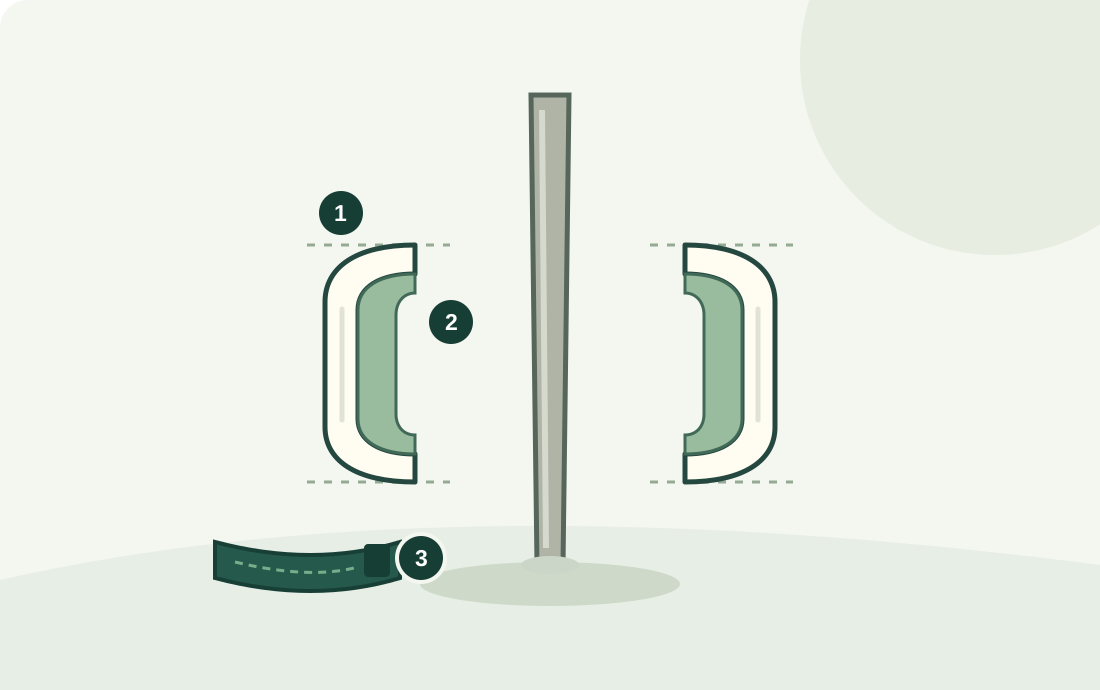
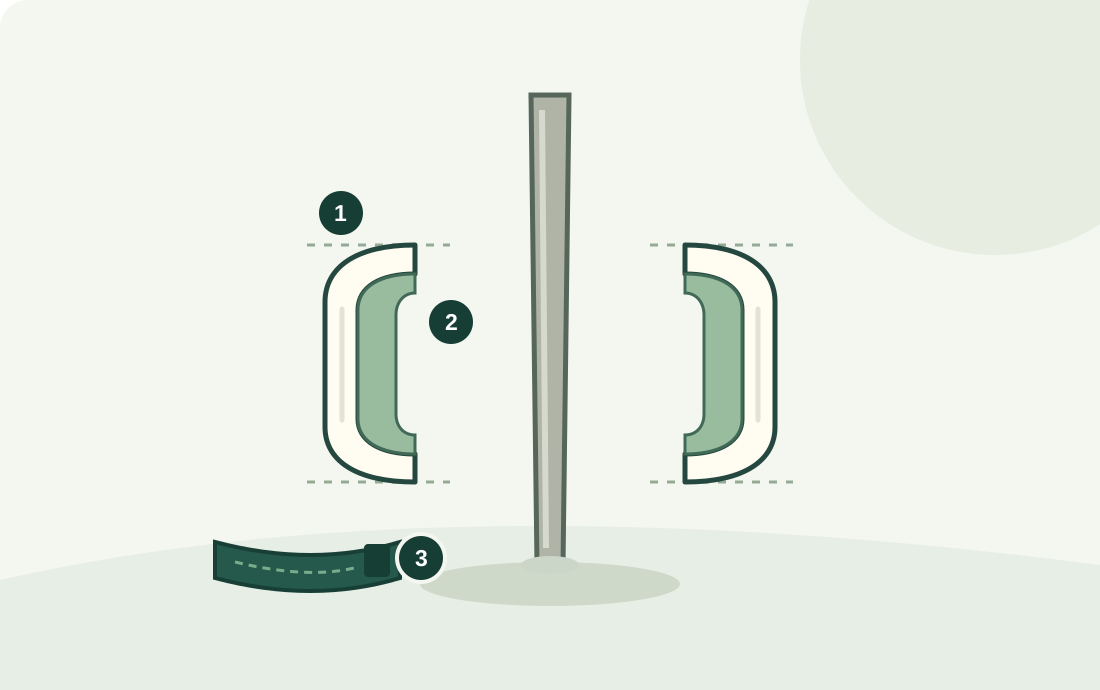
- 1 / Split outer sleeveTwo rounded halves create a larger target. Width and mounting height need hardware tests.
- 2 / Soft inner linersProposed compliant inserts grip the leg; furniture finish and slippage need checking.
- 3 / Reusable strapAn external closure holds the halves together without adhesive.
- Measure a repeat-contact leg and the relevant sensing zone on current Loona hardware; choose the prototype width and height from those tests.
- Place the two lined half-shells around the leg. The soft inserts are intended to grip the surface without adhesive.
- Close a wide external strap around the shells. Check removal, finish contact and stability when the chair moves.
- Observe autonomous approaches before expanding the kit. A broader surface is a detection hypothesis, not a verified avoidance fix.
Directions worth considering
Soft padding wrap
Benefit: Low cost, reversible and quick to compare; it can enlarge the leg and cushion contact.
Tradeoff: May compress, slip or look temporary. If it works well and is easy enough to use, it may be the better recommendation.
LegCue split sleeve
Benefit: Controlled larger geometry with replaceable liners and a reusable closure; potentially tidier fitting and removal.
Tradeoff: More parts and furniture variation. Sensing benefit, retention, appearance and finish compatibility all require tests.
Freestanding marker beside the leg
Benefit: Changes the local target without touching the furniture finish.
Tradeoff: Adds floor clutter, can move, and may become another obstacle or trip hazard.
Our recommendation: Test one LegCue sleeve against a bare leg and cheap matched padding. Proceed to a four-sleeve set only if real hardware results and owner preference justify the extra parts.
Build the first version
Build one split sleeve for one measured leg. Use two matte printed half-shells, compliant liner samples and a wide reusable strap. Do not design a full size range or buy tooling before testing the sensing effect.
Materials and production options
- Prototype matte PETG half-shells, compliant die-cut liner samples and a wide hook-and-loop strap. Material, finish and retention suitability are not yet approved.
- Compare surface finish separately from target width. Do not assume a visibly pale shell has a known response at the depth sensor's wavelength.
- If the concept works, compare molded polypropylene shells with replaceable TPE liners against a simpler foam wrap before tooling.
- Inspect wear, cleaning, dye transfer, compression and captured closures after repeated chair movement.
Prototype checks
- Record the actual robot revision, firmware, operating mode, lighting, furniture finish and leg dimensions. Rule out general sensor faults and use current setup guidance.
- Reproduce contact at that exact leg during normal autonomous behavior. Remote steering alone does not measure autonomous sensing.
- Vary test order across bare leg, generic padding, size-matched padding and the sleeve. Record early avoidance, contacts, stalls and any play response.
- Start with 20 comparable approaches per condition, then replicate in three owner setups if useful. These are proposed experiment sizes, not proof of market-wide performance.
- Check slippage, chair movement, removal, floor clearance and finish marking before any household-suitability claim.
05 / Business assumptions
Could this support a business?
This could become a small Loona accessory kit if a comparative hardware test shows a useful advantage and owners prefer the fitted design. A low selling price, furniture variation, assembly and delivery may make a standalone business impractical.
Price to test
Would an affected owner consider $19 USD for four sleeves? This is an unvalidated target-price question; delivery, taxes and final pricing are not settled.
Costs still to verify
No supplier quote or measured bill of materials is available, so no unit cost or margin is claimed. Cost eight shell halves, liners, four straps, assembly/QC, instructions, packaging, fulfillment, fees, returns and acquisition before choosing print-to-order or tooling.
Where the first customers might come from
A useful Loona obstacle-avoidance guide and a later measured comparison video could reach owners with this specific task. Owner-community distribution is a hypothesis, subject to its sharing rules; no traffic, partnerships or conversion rate is assumed.
06 / Next experiment
What should a builder test first?
The first decisive test: On current firmware, compare the same troublesome leg bare, with cheap padding, and with LegCue. Does target enlargement reduce autonomous contact without creating worse behavior—and does the fitted sleeve justify buying instead of padding?
Next validation steps
- Run the current-firmware comparison first; stop if the repeat-contact baseline cannot be reproduced.
- If performance improves, ask affected owners to fit and remove a sample and compare it with the inexpensive alternative.
- Test the proposed four-pack price with the concept page after explaining actual fit/performance limits. Waitlist interest is not a sale.
- Use the measured benefit and owner preference to decide whether to develop a small batch. No hardware purchases, interviews or signup submissions were made for this report.
What would make us drop this idea?
- Current setup or firmware solves the specific baseline problem without an accessory.
- The larger target does not reduce contact, or it worsens other behavior.
- Cheap padding works equally well and owners prefer its cost and simplicity.
- Owners dislike the appearance or cannot fit it securely without finish damage.
- The target price cannot cover the full delivered product and support cost.
Practical risks to check before going further
- Contacts may result from energetic behavior rather than missed sensing, so an enlarged target might not help.
- The sleeve could slip, mark a finish, obstruct chair movement, become a chewing target or protrude into a walking path.
- Leg geometry and firmware differences may prevent a useful affordable fit range.
- A wider leg may reduce passage space or attract play instead of improving avoidance.
- Low target price, fitting support, assembly, delivery and returns may erase the business case.
Explore building this idea
Start with the prototype plan and compare it with the existing alternatives. The consumer page shows how the proposed benefit and price could be presented to owners.
Go to the prototype plan ↑View LegCue for owners ↗07 / Sources
Sources behind this idea.
Post dates show when the underlying evidence appeared; checked dates show when the source was reviewed.
- Thin-leg sensing limitation in KEYi's 2026 guide ↗KEYi / Loona Team · Post · Checked
The manufacturer still describes thin chair legs as difficult sensing targets. Promotional manufacturer article; not independent current-firmware testing. No minimum target width or sensing height is given.
- July 2026 furniture-collision owner review ↗Trustpilot owner review · Post · Checked
A review describes energetic-mode contact with furniture. An isolated review marked verified, not a technical diagnosis. Firmware and leg geometry unspecified; individual permalink retrieval failed, so use the dated entry on this page.
- Loonaband face bumper and chair-leg buyer account ↗Etsy / CreatorySweden listing and buyer review · Post · Checked
An existing flexible bumper cushions contact; a buyer specifically describes chair-leg contact. One relevant account appears twice in the rendering. Retrieved listing is cached; its displayed price and availability are not a live quote. No prevention test is provided.
- Official Auto Recharge 2.0 route setup ↗KEYi / Loona Team · Post · Checked
The tutorial provides saved recharge paths and open dock placement as an existing setup alternative. Recharge routing does not establish all spontaneous roaming behavior. The sleeve must not obstruct the dock or saved routes.
- Official Loona product and appearance ↗KEYi · Checked
The current robot offer and official imagery establish the wheeled body, face and overall product architecture. Regional redirects and overall specifications do not verify furniture-sleeve geometry or sensing-zone fit.
- Loona on HomeRobotHQ ↗HomeRobotHQ · Checked
The exact indexed model's profile supplies robot context and a related ownership route. The profile is not evidence of demand for the proposed accessory.