
01 / The opportunity
Why might someone buy this?
The case for paying is a removable textile contact surface without permanently coating a valued mask. It must feel meaningfully better than the current mask while remaining easy to fit and clean; otherwise there is no reason to buy it.
Who might need it?
- Current KAMOMO owners who notice and dislike the harder face surface during gentle touch.
- Owners who want a reversible texture change while keeping their existing mask and fur.
- Not needed for owners happy with their current surface; not a replacement for a damaged mask or a promise of therapeutic benefit.
The owner task is enjoying physical touch, rather than fixing conversation, memory, charging or a damaged robot. A textile accessory cannot improve those software behaviors.
No completed textile-face DIY was found. The observed owner suggestion concerns a softer coating; the connected removable carrier and edge-clip approach are proposed here, not attributed to an owner.
02 / Existing solutions
How owners handle it today.
| Current solution | What it does | What remains |
|---|---|---|
| Keep the original magnetic mask ↗ | Preserves the intended face geometry and straightforward wipe-clean routine documented by Ropet. | It leaves the surface that the March owner account dislikes. Other owners may find it entirely adequate. |
| Buy a replacement color mask ↗ | Official Black and Candy Pink masks offer a ready-made appearance change, displayed at $26 and $30 USD respectively. | Their retrieved descriptions do not establish a textile contact surface. Their actual feel should be compared before treating SoftCheek as an improvement. |
| Choose an existing seasonal outfit/mask ↗ | Ropet already offers a Mini Skeleton Outfit. A retailer describes its mask as made from soft materials, making it a relevant alternative to investigate. | The retailer wording does not specify a textile surface or measured softness. The original maker image shows a shaped face mask; it cannot establish feel. The candidate fails if this option already delivers the desired experience. |
What a better product would need to do
- Make a cheek stroke feel preferable to the original and suitable current masks; compare equivalent clean surfaces, not just visual appeal.
- Preserve eye openings, central camera field of view, upper aperture, touch behavior, fur fit and the full moving-part envelope.
- Keep the original magnetic mask seated, with no extra magnets, glue on the robot or pressure on displays.
- Use one connected carrier with captured textile edges; avoid loose clips, shedding fibers, snagging and sharp contact edges.
- Remove the whole accessory for care. Prove it can dry fully, retain shape and refit without making maintenance harder.
03 / Research evidence
How strong is the evidence?
Opportunity type: Explicit owner texture preference and a niche accessory improvement.
The relevant March 19, 2026 forum post describes disliking Ropet's hard faceplate and suggests a suede-like surface. This is an isolated preference, not a recurring complaint. Current official masks are comparators; a retailer also advertises a seasonal mask as soft. No hands-on texture comparison establishes that the need remains unmet for every current mask.
A March 2026 owner account states a preference for a softer faceplate. Ropet's current support describes removable magnetic masks; its store lists separate masks and fur accessories. Official images show eye openings, a central aperture and a small upper aperture.
A removable cheek surround may test tactile improvement without replacing the magnetic mask. Keeping the upper and central face open reduces what the first prototype attempts to cover; it does not establish sensor clearance or a useful feel.
How many current owners share this preference; whether existing masks already satisfy it; whether a partial textile surface is appealing; exact mask revisions, clip seating, motion clearance, temperature and a durable cleaning method.
Selected evidence
March owner texture preference ↗
The relevant post #6 describes disliking Ropet's hard faceplate and suggests a suede-like finish. No completed modification is shown.
Post: · Checked: An isolated first-person preference within a Pophie comparison thread; not evidence of recurrence or purchase intent. Exact Ropet revision unspecified. A direct post link could not be retrieved; locate post #6 dated March 19. No user material retained.Official mask and fur care ↗
Documents magnetic mask removal and gentle wipe cleaning; gives separate hand-wash guidance for removable fur. Pairing instructions align a phone QR code with the nose area.
Checked: Undated current support. These instructions apply to official parts, not the proposed textile overlay or its care method.Current Black mask and aperture image ↗
Displays $26 USD and one review. Official image shows two eye openings, a central opening and a tiny upper aperture.
Checked: Listed price and reviews may change; no checkout or measured texture test. Image proportions do not verify dimensions, clip geometry or the upper aperture's function.Existing seasonal mask alternative ↗
The indexed retailer listing calls the item a Skeleton Mask, displays $59 and describes soft materials. It is a relevant existing alternative to compare.
Checked: Retailer copy does not establish textile construction, tactile preference or safe clearance. Full-page retrieval failed; currency/destination and the actual material require confirmation. Do not convert its marketing claims into tested facts.The March account provides an explicit tactile preference. Retrieved official Black and Candy Pink listings display one and two reviews respectively; the seasonal outfit displays nine. These indicate an offered accessory range, not sales volume, representative satisfaction or demand for SoftCheek. Review dates and community-size-normalized engagement were unavailable.
Search interestNo dependable keyword volume, accessible Search Console export or reproducible Google Trends series was available. Ropet mask, KAMOMO accessories and Ropet faceplate are discovery phrases, not proven traffic. A useful comparison should answer texture, fit and care questions before pitching the concept.
04 / Product design
How the product could work.
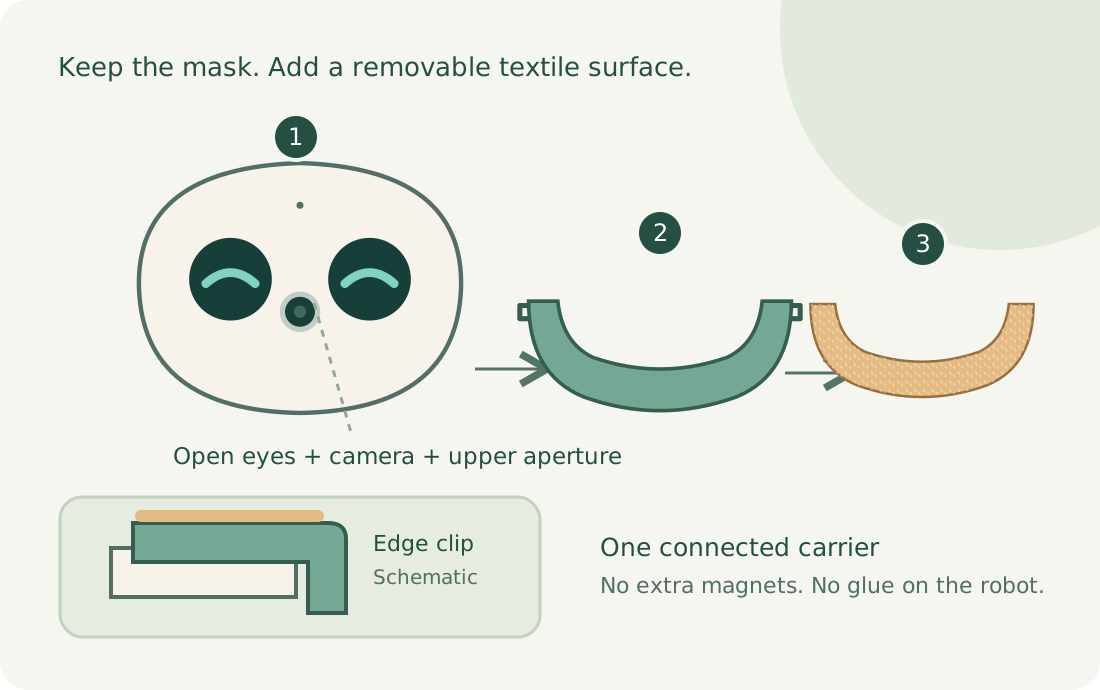
- 1 / Keep the original maskIts magnets and apertures remain. Measure the actual revision and moving clearances.
- 2 / Connected carrierRounded edge clips are proposed attachment points; seating and retention are not verified.
- 3 / Textile contact surfaceShort pile along the cheeks and lower face. Leave the top, eyes and camera area open.
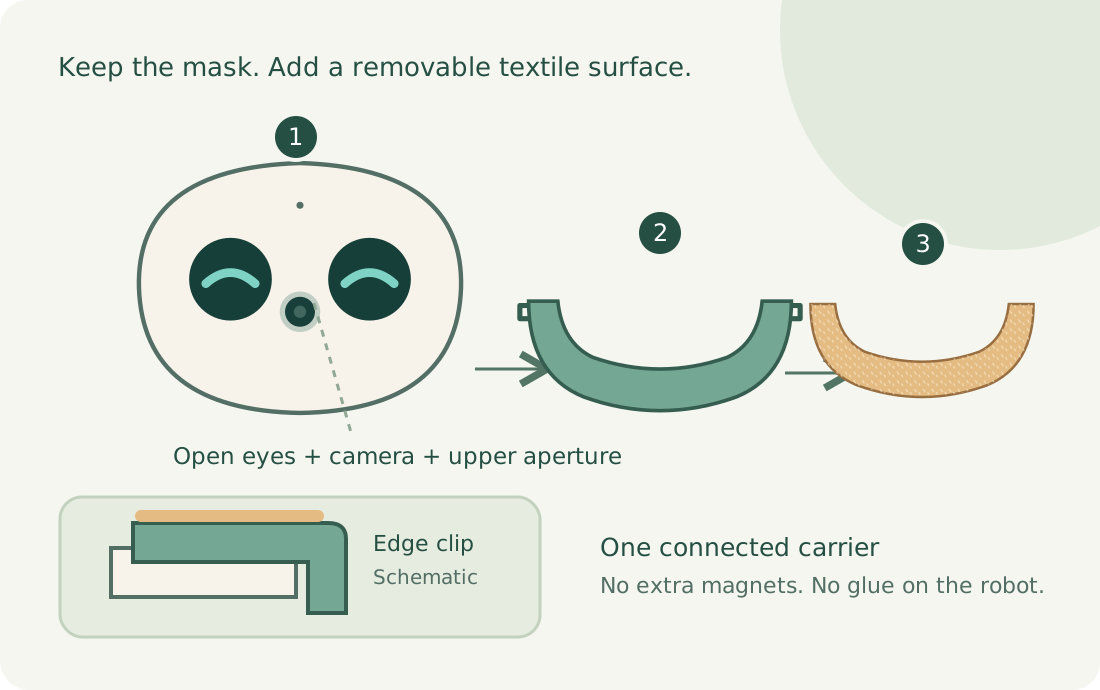
- 1 / Keep the original maskIts magnets and apertures remain. Measure the actual revision and moving clearances.
- 2 / Connected carrierRounded edge clips are proposed attachment points; seating and retention are not verified.
- 3 / Textile contact surfaceShort pile along the cheeks and lower face. Leave the top, eyes and camera area open.
- A shallow connected U-shaped carrier follows the cheeks and lower perimeter of one measured mask. Rounded clips locate on accessible mask edges; their exact form depends on measurements.
- A short-pile textile surface is captured or bonded to the carrier, with finished edges facing away from the displays and central camera. Any adhesive is part of the accessory, not applied to the robot.
- The upper face and the central region stay open. Check wide-angle camera rays, every expression, the small upper aperture, fur seating and full motion before settling the outline.
- The owner removes the whole surround before mask removal or textile cleaning. Refitting must not change magnetic seating, retain damp material against the robot or leave loose components.
Directions worth considering
Coat a spare mask with a thin textile
Benefit: A quick bench sample tests feel before developing a fitting mechanism.
Tradeoff: A permanent finish complicates cleaning and can cover openings. Use a separate spare for experimentation, not adhesive on an owner's robot; compare the texture before building a consumer product.
SoftCheek removable lower-face surround
Benefit: Adds textile where the hand meets the cheeks while keeping the original mask. The whole assembly can be removed for comparison and care.
Tradeoff: Partial coverage may disappoint; edge clips may not seat securely without disturbing the mask or fur. Actual geometry decides feasibility.
A complete soft-faced replacement mask
Benefit: Could offer a more uniform feel with fewer visible seams.
Tradeoff: Requires reproducing the magnetic interface and all optical, thermal and motion clearances. It adds fit and tooling complexity before proving that owners want a different surface.
Our recommendation: Test textile preference first, then prototype the removable lower-face surround. Do not invest in a replacement mask until the simpler sample beats relevant current accessories and a measured attachment can preserve normal operation.
Build the first version
One connected, shallow U-shaped carrier with short-pile textile on its outward face. Rounded edge clips would locate it around one measured original mask, without adding magnets or gluing to the robot. Keep the top and central sensing areas open. Supply a fitting/care card; the owner supplies KAMOMO and its mask.
Materials and production options
- Begin with washable short-pile synthetic textile samples. Compare feel, lint, dye transfer and drying; natural suede's appearance alone does not make it the best care choice.
- Print a low-profile TPU carrier with rounded integral clips for fit iterations. Printed roughness and flex-fatigue need examination before any owner trial.
- Compare stitched edge capture with accessory-only textile bonding. Test cleaning cycles, seam lift, shedding and whether a removable fabric layer creates loose parts.
- If useful, quote die-cut textile, edge finishing and a molded flexible carrier. Do not order tooling until the mask interface and material combination pass hardware checks.
Prototype checks
- Identify the exact KAMOMO unit, mask, fur, hardware revision and firmware. Compare the feel and care routine with available masks, including the seasonal option, before assuming an unmet current gap.
- Measure mask curvature, accessible edges, seating, all apertures and motion clearances. Keep the tiny upper aperture open without assigning it an unverified function.
- Use a removable bench textile sample to test tactile preference. If partial cheek coverage feels insufficient, stop the surround direction before refining its clips.
- Make a one-piece carrier and inspect removal force, pull-off behavior, clip fatigue and textile edges with the robot off. Reject it if the mask shifts or a piece can separate.
- If fit passes, compare powered camera framing, QR pairing, expressions, ordinary touch response, complete motion and surface temperatures with and without the surround. Remove immediately if operation changes.
- Run five remove/clean/dry/refit cycles as an initial experiment choice, checking odor, drying, lint, color transfer, shape and attachment. This is a prototype screen, not a durability certification.
05 / Business assumptions
Could this support a business?
This could be a focused tactile accessory, not a broad replacement wardrobe. A $24 target must cover textile finishing, attachment inspection, packaging, delivery and revision support. Existing masks displayed at $26–$30 are comparison prices, not evidence of what owners will pay for an overlay.
Price to test
Would an affected owner consider $24 USD for one surround? This is a target-price question, informed by current masks displayed at $26–$30 before delivery and tax, not a validated willingness to pay.
Costs still to verify
No supplier quote, measured BOM or unit-cost estimate is available. Obtain quotes for carrier production, textile cutting/finishing, assembly, fit inspection, packaging, fulfillment, fees, returns and model support before estimating delivered margin.
Where the first customers might come from
Useful content about KAMOMO masks, tactile customization and cleaning could reach current owners through the robot profile and relevant search queries. A later preference demonstration should compare real surfaces. No search traffic, audience size, partnership or conversion rate is assumed.
06 / Next experiment
What should a builder test first?
The first decisive test: On one identified KAMOMO mask, compare the original surface, an appropriate current accessory and a temporary textile cheek sample. Is the smaller soft area actually preferred, and can a removable carrier hold it without disrupting the mask or sensors?
Next validation steps
- Start with a later consented comparison among six current owners who say they dislike their mask's feel. Six is a proposed exploratory sample, not evidence already collected or a market benchmark.
- Compare the original, an appropriate current mask and a removable textile cheek sample in varied order. Ask which feels better, whether partial coverage is enough and which would be used after a week.
- Proceed to wearable-on-robot fit only after both preference and bench retention pass; do not substitute a compelling animation for that hardware gate.
- Use the concept page to distinguish owners seeking texture from those seeking a color change and ask about $24. Waitlist interest is an early signal, not a purchase or proof of demand.
What would make us drop this idea?
- Owners with current masks do not notice or dislike the surface, or an available accessory already satisfies their preference.
- A texture comparison shows no useful preference for the partial surround over the original or a simpler alternative.
- There is no accessible attachment geometry that preserves mask seating and normal operation.
- Cleaning, drying, shedding or warmth makes the accessory less pleasant or harder to maintain.
- The preferred version cannot be offered at a delivered price owners would consider.
Practical risks to check before going further
- An existing mask may already offer a satisfactory feel, or owners may prefer the cleanable original face.
- A textile surround could shed, retain moisture, trap warmth, collect dirt or transfer color.
- Clips could disturb magnetic seating, scratch the mask, snag fur or interfere with the moving body and arms.
- Unmeasured camera rays or the small upper aperture could be obstructed even when holes look clear head-on.
- Partial cheek coverage may not deliver the more uniform plush feel the owner wanted. There is no established child-safe, pet-safe or therapeutic claim.
Explore building this idea
Start with the prototype plan and compare it with the existing alternatives. The consumer page shows how the proposed benefit and price could be presented to owners.
Go to the prototype plan ↑View SoftCheek for owners ↗07 / Sources
Sources behind this idea.
Post dates show when the underlying evidence appeared; checked dates show when the source was reviewed.
- March owner texture preference ↗Robots Around The House / public owner discussion · Post · Checked
The relevant post #6 describes disliking Ropet's hard faceplate and suggests a suede-like finish. No completed modification is shown. An isolated first-person preference within a Pophie comparison thread; not evidence of recurrence or purchase intent. Exact Ropet revision unspecified. A direct post link could not be retrieved; locate post #6 dated March 19. No user material retained.
- Official mask and fur care ↗Ropet · Checked
Documents magnetic mask removal and gentle wipe cleaning; gives separate hand-wash guidance for removable fur. Pairing instructions align a phone QR code with the nose area. Undated current support. These instructions apply to official parts, not the proposed textile overlay or its care method.
- Current Black mask and aperture image ↗Ropet store · Checked
Displays $26 USD and one review. Official image shows two eye openings, a central opening and a tiny upper aperture. Listed price and reviews may change; no checkout or measured texture test. Image proportions do not verify dimensions, clip geometry or the upper aperture's function.
- Current Candy Pink mask ↗Ropet store · Checked
Displays $30 USD and two reviews, with color-focused product copy. No retrieved technical texture specification. Reviews do not measure sales or establish that owners need a softer surface.
- Current KAMOMO product and configuration ↗Ropet · Checked
Current KAMOMO offer lists Pro and other bundles, with touch-focused use imagery and US shipping information. Pro is displayed at $469 in this retrieval. Retrieved price is not a confirmed paid total. No checkout, installed-base estimate, hands-on test or equivalence of all mask revisions established.
- Existing seasonal mask alternative ↗TOYTAG retailer · Checked
The indexed retailer listing calls the item a Skeleton Mask, displays $59 and describes soft materials. It is a relevant existing alternative to compare. Retailer copy does not establish textile construction, tactile preference or safe clearance. Full-page retrieval failed; currency/destination and the actual material require confirmation. Do not convert its marketing claims into tested facts.
- Official Mini Skeleton Outfit ↗Ropet store · Checked
An official outfit/mask alternative is offered with nine displayed reviews. The standalone page displays $100, while its collection displays $75; the official image shows a shaped mask and separate fur. Conflicting page prices mean no dependable paid total was confirmed. Images cannot establish hardness or feel; review dates were not exposed. Compare the actual mask before claiming an unmet texture gap.